In the long run this will also be the future of merchant shipping. We can't generally install nuclear reactors in civilian vessels due to high costs and security concerns. But we can use nuclear power on shore to produce carbon neutral synthetic fuel, then run ships on that.
-Reactors are extremely capital-intense to produce and manpower-intense to operate. Security costs would also be high.
-Merchant ships have a build-scrap cycle of ca. 30 years. That's a lot of reactors to regularly decommission, a very expensive task.
-A reactor running on low-enriched uranium would not be useful for making a nuclear weapons, but a malicious actor could make a dirty bomb.
The US Navy used to have nuclear-powered cruisers, and phased then out because it wasn't really worth it. Nuclear propulsion only makes sense for a few tactical cases, like submarines (which can't use air-breathing motors underwater) and carriers (huge ships that routinely steam into the wind at very high speed for flight operations).
The issue with carriers is they want to carry as much jet fuel, supplies, and munitions as possible to minimize the amount of refining and resupplying they need to continue operating. Plus space for their crew, aircraft storage and repair etc. On top of this they need vast amounts of electrical power for internal operations and the ~6,000 personnel onboard.
It’s so bad the Navy is seriously looking into generating jet fuel onboard via Nuclear power. Even if it’s not cost effective it would be a huge logistics benefit.
USN phased out the CGNs mostly during the collapse of the military after the Soviets quit. CGNs are extremely useful, and as directed energy weapons become common, will have a place in the Navy.
The US Navy has no plans to use nuclear power in the Large Surface Combatant program. Those are the only cruisers they're likely to get over the next several decades. Regardless of potential advantages the budget just isn't sufficient for nuclear.
The LSC will never float anyways. We'll just continue to build Burkes. Columbia, Ford-Class CVNs and Virginia SSNs will eat all of the Navy's shipbuilding budget. 2020-2030 is going to be a hard time for the USN.
I think we'll see FFG(X). Odds are the shipyards building the execrable LSC will win the contract, and the Congresscritters will want to keep those jobs going.
Depending on the chosen config, the FFG(X) might end up being a good vessel; we'll need lots of them.
There's some issues with pirates in many parts of the world though (source: Captain Phillips movie). It's just not practical to really secure container ships from every feasible sea and air attack surface, unless there was a big red button that just drops the reactor into the depths of the ocean.
And even without pirates, merchant vessels have incidents with disturbing frequency. A lot of these incidents never have a cause firmly attached to them, because the crew's all dead, the ship is somewhere in a 10,000 square kilometer stretch of ocean, and that ocean is 1km+ deep. Not that the wreck being known and (relatively) shallow is a panacea either, as the variety [0] of hypotheses concerning the cause of the Edmund Fitzgerald wreck should demonstrate.
I trust the US Navy to operate reactors at sea - they've done a damn good job of it over the years, with no losses since 1968. And even those losses (USS Thresher, SSN-593 [1] and USS Scorpion, SSN-589 [2]) haven't caused radiation leaks. Merchant shippers? Yeahhhhh.... No.
Maybe you could get the US Navy to crew a few container mega-ships in the national interest of international commerce? Reducing climate change and political concern over the carbon involved is arguably a better use of the Navy's time than fleet exercises, and it wouldn't take that many people.
There are over 9,000 fully cellular container ships operational right now, and container ships are only 13% of global merchant shipping capacity. The roughly 70 ~20k TEU megaships all together are only 10% of total container ship capacity. A few megaships is insignificant in overall economic terms.
How often are subs lost? I have no recollection of numerous losses, but I think they’re also only ran by nations. I wonder if they’re inherently more stable.
I'm pretty sure submarines are lost more often than surface warships are - the difference between small incident and loss of ship is just so much smaller. And to confirm that I can't think of any surface warships that have been lost by the US or Russian navies out of combat since 1950, but both have lost several submarines in that same time period.
Other entries would be USS Benevolence [0] in 1950, USS Hobson (DMS 26) [1] in 1952, USNS Mission San Francisco (T-AO-123) [2] in 1957, USNS Mission San Miguel (T-AO-129) [3] in 1957, USS Stickleback (SS-415) [4] in 1958, USS Grouse (AMS-15) [5] in 1963, USS Bache (DD-470) [6] in 1968, USS Frank E Evans (DD 754) [7] in 1969, USNS Sgt. Jack J. Pendleton (T-AKV-5) [8] in 1973 and USS La Moure County (LST-1194) [9] in 2000.
But I think that's the rest of the noncombat, post-1950 losses. Lots of support ships, DDs and a single sub.
And thanks for the mention of the USS Guardian - I had no idea the USN still operated wooden-framed ships!
I agree there's a problem with pirates in some parts of the world. Source: I used to work in this area.
I recall a shipping lane chart that showed large carriers making a wide swing around and away from somalia.
Ships can be obscenely ill-regulated at sea. Also the crew is, due to greedy owners, a skeleton thereof and paid like dirt (and not necessarily treated much better). Anyone pushing for nukes on large ships needs to work in the industry first before opining.
Pirates aren't stealing nuclear fuel from operating reactors. It will literally kill them before they get away with it.
They could potentially breach a reactor deliberately but again...why? It would kill them and not achieve anything.
The design for nuclear reactors in commercial shipping has been to use sealed modular units, who's security system would be that attempting to remove or breach would drop the whole unit to the bottom of the ocean where only nation-state level specialized resources could recover it expediently.
Um... I'm going to assume this isn't a troll or written while inebriated. What's the big deal for weapons of mass distruction. Okay well dirty bombs for one are easy to do once you have the nuclear material.
Maybe Somalian pirates are relatively chill on the non nation state armed groups out there crazy scale but ISIS and many other terror groups most definitely are not chill. When someone even figures out how to build a powerful conventional explosive you get things the Oklahoma City bombing.
So yeah that's kind of a big deal. The US did essentially invent the weapons and only one to use them in warfare. I think it's also the responsibility of the US make sure it doesn't happen again where they are used against humanity.
US was even committed to building two LWR nuclear reactors in North Korea in the late-90's, and as per reports, even some work had started on the sites. If US can provide nuclear reactors to North Korea, I think there wouldn't be much fear of these reactors being repurposed for a weapons program.
The program you're referring to was about swapping out North Korea's breeder reactor program, designed to generate enriched weapons grade fissile material, for LWR reactors not usable for generating weapons grade fissiles.
They absolutely could be used to produce material for dirty bombs, but that's not a factor with North Korea, which has plenty of material to do that anyway.
Why is it a great reply? It does not explain the fact that US would handover two nuclear reactors to North Korea sounds such a bold step, diplomatically speaking. Would US do that today with North Korea or even other countries.
OkC isn’t a great example anymore. Many security systems are in place to keep that from happening again. Takes a lot more these days. Fools with nukes have a way of harming themselves. Even Putin did so recently with his nuclear rocket blowing up.
The reactor would spend the vast majority of it's time running at much lower than peak capacity, which is a huge waste. An on-shore reactor can be put next to a rich CO2 / CH4 source such as a cement factory, and run at full capacity continuously feeding fuelstock to a whole fleet of vessels. It's tremendously more efficient.
> The reactor would spend the vast majority of it's time running at much lower than peak capacity, which is a huge waste.
Not so sure about that. I think current trans-oceanic cargo ships generally run at fairly high fraction of peak power (otherwise they could have saved money buy buying a smaller engine in the first place). Also port operations tend to be pretty fast and efficient these days.
Of course, for ships running shorter distances and spending a larger fraction of their time in port loading and unloading, synfuels, hydrogen or for really short routes even batteries are probably going to be a better option.
How is a reactor at partial power less efficient? I suspect you're not talking about thermodynamic efficiency, and it's not energy that (you think) would be wasted.
> How is a reactor at partial power less efficient? I suspect you're not talking about thermodynamic efficiency, and it's not energy that (you think) would be wasted.
Efficient in an economic sense. Nuclear plants are generally capital intensive, whereas fuel is very cheap. So you want to run them at close to max power as much as possible to recoup capital costs. But contrary to the previous poster, I think trans-oceanic ships generally do that.
And the russians still have that nuclear icebreaker. The line between military combat ship, merchant marine, coast guard and fully civilian vessels is not bright, nor need it be. There is probably a case for running government-protected reactors on commercial ships, just as government-protected reactors power cities.
What's the need for these icebreakers? I can understand that a nuclear icebreaker is a good thing for breaking ice - but I don't understand how it's economical. Is there really so much value in bringing cargo through pack ice?
That seems like a very bad idea unless they each get a gunship(s) to prevent pirates and freedom to fire on anyone who doesn't hail back as they approach the ship.
Pure FUD. No commercial design uses highly-enriched uranium directly. The difference in effort between reactor-grade and bomb-grade fissile material is billions of dollars in time, effort, infrastructure and materials.
Please use language honestly rather than reinforcing ignorance and hysteria.
> Check out current ship and sub reactors, the overwhelming majority run on HEU.
The overwhelming majority are military, who are not as constrained by non-proliferation concerns as civilian users. So this doesn't really prove anything.
As for whether it's technically possible to have naval reactors using LEU, yes it is, for instance French submarines run on 7% enriched fuel.
> I have never seen anyone talking about ship reactors on HN mention not using HEU.
When talking about a hypothetical large-scale use of civilian nuclear powered ships, I think it's a given.
while having been a fan of nuclear power for ages i expect we will reach such an excess of wind and solar that converting to fuel for use during off peak times will become to economical to pass up.
CO2 emissions are globally fungible, that's the whole idea of the climate change problem. So I don't understand the marketing of "carbon neutral" products. You can produce an infinite amount of carbon neutral stuff, and it has no more value than printing a label. The idea of a bottom-up solution makes no sense to me.
The idea of building up carbon neutrality bit by bit reminds me of Eddie Lampert's much ridiculed apparent belief that you can build a profitable company by having smaller parts of it compete to make profits.
Generally, building things on land has substantially other constraints than on a ship. You have substantially more space and weight is much less of a concern. Usually, power plants on land are built much larger than on sea, leveraging different scale economies.
True, though the promise of all these SMR's under development currently is to leverage series manufacturing and get cost savings that way, rather than scaling everything up ever bigger as traditional nuclear plants.
If it turns out SMR's meet their promises, I guess the same economic principles could be applicable for ships as well.
Fair point. Though small nuclear power plants haven't really been a thing so far, and GHG emissions hasn't been such a big issue either. And thus diesel generators have been the default choice.
Nuclear reactors are cost-efficient on large scale, and quite expensive on smaller scale; if you have nuclear reactor that makes 100 times less power, you don't get 100 times less complexity/risks/maintenance/manpower/etc.
Nuclear power makes sense for if you need a lot of power for a ship and/or very long range without refueling, so aircraft carriers, missile subs and (barely) long-range icebreakers are a good fit; but diesel is not a big problem for a ship that's designed to be fuel efficient and is on a route where it can refuel frequently.
It seems to be around the wrong way. We need the nuclear reactors providing constant reliable power day and night to the grid, whereas variable renewables such as solar are better for creating synthetic fuels since to be viable on a large scale they need to be combined with a form of storage anyway, which is what the synthetic fuels would be.
"Reactors that could power the hydrogen extraction are small enough to be transported by truck and would occupy a building one-10th the size of a nuclear power station."
They are talking about a specific type of small nuclear reactor tightly coupled with the synthetic fuel generation.
Just speculating, but the waste heat from the nuclear reactor itself could be fed into the fuel synthesis process, making it a sort of combined cycle system. That could be more efficient than trying to use renewables, which generate very little in the way of waste heat.
Fischer Tropsch is typically what people are talking about when they talk about synthetic fuels, and when that is the case, extra heat doesn't help, apart from starting the reaction. You need enough heat to get it to about 250-300C, but once the reaction has started, you need to aggressively remove heat from the reactor, as the reaction is highly exothermic.
Even so, seems like pricing would work out better with the reactors attached to the grid. Lock in a rate for providing baseline power, and then bid for renewable energy to power the facility when spot prices are low enough at times of peak production, and ramp up synthetic fuel production at the same time.
You can keep using process heat from the reactor since it's already operating anyway, but get much cheaper electricity (sometimes even negative prices!) from peak renewable generation and turn that into synthetic fuels for storage.
The challenge with many environmentally-powered renewables is specifically that they can't be used for spot production.
Nuclear tends to share this. Most nuclear reactor technology is not optimized for rapid swings in production. A reactor is a very expensive thing to not run most of the time.
The two technologies aren't terribly compatible. The first tend to be intermittent (not great for on demand needs) and the second are best suited for base load.
What you need is something that is relatively cheap to maintain, and can be ramped up quickly. This is where you typically see natural gas peakers in a fossil-fuel based system.
For peaking demand you need something that can store energy and can adjust to load rapidly. Batteries do this (I include mechanical solutions as batteries, e.g. a flywheel or pumped hydroelectric). Natural gas plants tend to fill this role now. These are not the only options, just common examples.
In short, yes, but there are limits. A really (really) rough analogy would be filling a tank of water. If you fill it faster than it can drain, eventually it will overflow. If it is sealed, it may burst. The grid equivalents of an overflowing or bursting tank are not great scenarios.
And with intermittent energy sources, there are additional problems. We only get energy sometimes. We want energy always. It basically inverts the idea of base load and peak load sources. If your source is intermittent, then you do want to be able to over-produce at certain times, with an ability to capture the energy. Think batteries, but know that they need not be chemical batteries. Energy storage can then cover the valleys of production or the peaks of demand.
Add coordination to the challenges as well. Much (most?) solar is distributed. It's much easier to ramp generation up or down in a few centralized plants. If every home has a solar panel array, then you need to be able (either at the local or the grid level) be able to store excess energy or turn off production.
None of this is insurmountable, but there are many challenges that are non-trivial by nature and some that are difficult d/t the way energy grids are typically set up.
In an efficient market that's probably the way to go. But it depends partly if your production process can scale up and down easily, which is rarely true in general. It could be designed like that though.
That depends on the capital expense of the fuel plant. If it's a high percentage of the fuel cost, then it needs power 24/7.
On the other hand if energy is the dominant cost, then it's best to take cheap low-cost energy and shut down fuel production other times. That would apply in a nuclear grid as well; you could keep your nukes running 24/7 and run the fuel plants when demand is low.
> The plants, costing 1.8 billion pounds ($2.4 billion) apiece, would feed the national grid and come online from the 2030s, with all complete by 2050.
I agree, replace all the current coal/natural gas/etc factories with nuclear. It's here, it's well understood and it can be done. It will serve us well until fusion is perfected. It will end the global warming issues and we can even take older more fallible reactors offline.
Nuclear reactors must be periodically shut down for days to months at a time for maintenance. That fact often fails to be mentioned when the 'constant reliable' claim is raised. The Sun, on the other hand, rises each day.
Renewables 'on a large scale' become less reliant on storage. Their 'viability' depends on the grid connecting them. On a continent-sized grid the wind is very likely to be blowing. Coupled with full-scale decentralized storage, the viability question blows away.
Clean energy seems wildly impractical for airplanes. There is no battery tech approaching kerosene for power density, and unlike fuel, the battery doesn't get lighter as it's used up.
The article suggests compressed hydrogen. Although that has obvious problems (at some point there is probably a tradeoff between increased density and the weight of the storage tank required to safely hold that density, which directly related to energy density) and probably more subtle problems, it would be clean-burning.
Edit: Random wikipedia page[1] gives energy density of "jet fuel" as 35 MJ/L and liquid (i.e., about as compressed as you're going to get) hydrogen as ... 8.5 MJ/L. Yeah, that's not even close, nevermind. LNG gets you to 22 MJ/L, which is still 2/3 of the density and requires storage at -160°C, which costs more energy, etc, and isn't clean-burning (but maybe slightly better than kerosene).
But a liter of compressed hydrogen weighs 38 grams, while a liter of kerosene weighs 810 grams. So the energy density by gram, rather than liter, is in favor of compressed hydrogen by a factor of more than 5x.
I don't know what the tradeoff is between volume and weight in aviation, but it's worth noting that we can measure density by both volume and weight, and by weight compressed hydrogen defeats kerosene.
If you are going to compare hydrogen and kerosene by weight you need to include the weight of the containment vessel. For kerosene that is a thin piece of aluminum. For hydrogen it is...not.
So, for sleek jets, heavy but compact jetfuel will rule. But for zeppelins, the weight-to energy ratio is much more important, as they have plenty of volume to spare..
They are not suggesting hydrogen. The article is specifically about _electrofuel_, which is extracted from a mix of hydrogen and carbon dioxide in a very power-hungry process; it’s a transparent liquid similar to diesel, and energy density is not too far off.
As jemfinch points out the value that is important is the Wh per kg, or MJ per 1000 kg, not the liter volume. Though certainly the carbon fiber composites tanks required to store hydrogen at very high pressures are not light in weight.
One of the reasons why electric aircraft are currently very short range is that the best li ion batteries top out at 250Wh/kg.
Liquid ammonia contains 15.6 MJ/L (half of diesel). Ethanol - 24MJ/L. Methanol - 15.6NJ/L. Mix of ethanol or methanol with ammonia can replace gasoline[1][2]. Both ethanol and ammonia can be generated from air using solar energy.
Hydrogen is much lighter though. You wind up with big ugly planes that are lighter than the planes we have now. Apparently they’ll be able to use shorter runways as well.
I believe the idea is that you can use hydrogen to synthesize kerosene, which assuming you use clean energy inputs, is carbon neutral. There was a similar sort of startup that showed up on HN a few months ago.
If they were serious about this I would think they make an effort to start building such a project in a country where the chance of regulatory approval is better than a snowball's chance in hell. Like maybe somewhere in the Middle East, near several mega airport hubs, existing shipping routes for fossil fuel shipments (e.g. natural gas), and a political environment eager to establish an industry on the upswing that complements existing competitive advantages.[1]
[1] I know the Middle East isn't very strong in the high-end, value-add part of the energy supply chain--refining, etc. But this would be a perfect way to rectify that.
Middle east doesn't work, there is a connection to nuclear weapons. I honestly can't think of a country that fits your criteria. China? Maybe? But that's iffy and comes with other issues. NK? But working with NK or any country that is going to violate nuclear arms treaties (cough Middle East cough) you're going to have a hard time doing business with the first world. Which means that if you're a business trying to do this that you have to be completely funded by said country that will violate those treaties because you are giving up your other revenue streams. I don't imagine Rolls-Royce wants to give up their current revenue streams and work with dictators for this high risk endeavor.
Singapore probably. They already have a hugely cancerous, in the traditional sense, chemical industry within a stones throw away from major population zones. Throwing some nuclear into the mix will be a step up in terms of environmental damage.
Yes, they are smart enough to have the Malays and Indians working with the truly heinous chemicals. Maybe Mainlanders now - haven't been there since the 00s. So much better on your statistics when the people dying do it back home, after you have worked them 8/9ths to the grave.
That issue crossed by mind, but I think there's a fighting chance it could work out. I had in mind Oman, Bahrain, Qatar, or Kuwait. Those countries already have a long and comfortable relationship with the West and the UK in particular, stemming from colonial times. (At least a good relationship with the corporate and political elite.) Especially with the UK I think that relationship is strong enough to resist the boogeyman of terrorism and the optics of working with those regimes, which don't have particularly poor reputations in the UK or US, anyhow. The "special relationship" between the US and UK means the UK has more license to exploit those ties, even though I'd assume any outcry would be loudest from the US.
It would need to be made clear that Saudi Arabia would be kept at arms length, to mitigate (at least superficially) the threat of nuclear escalation between SA and Iran. But from a technical perspective I'd assume any proliferation risk would be minimal to nonexistent given the technology. Plus there's always the option of Rolls-Royce keeping the core know-how in-house, perhaps building most or all of the module in the UK, only fueling it in the host country.
With Brexit there will be tremendous pressure for the UK to find and develop such cooperative, bilateral projects. In any event, we all know nuclear is dying (and mostly dead) in the West. So it's either something like the above, or nothing at all.
If a nuclear expert is working in the middle east they will seriously have "get assassinated by Mossad" on their list of concerns. And that isn't hyperbole, it is just reasonably unlikely.
Planning a politically fraught project literally sandwiched between Iran and Saudi Arabia is a level of risk that needs very cautious consideration. It wouldn't be at all surprising if a major power just quietly says "No, you can't encourage that sort of expertise in this region". There are a whole bunch of "they wouldn't do that it is illegal" style possibilities that would not happen in the UK that could reasonably eventuate in the Middle East. Including invasions related to oil shipping.
Finding an oasis in the desert does not mean one is safe from dust storms.
So I did some digging. Many countries in the Middle East already have plans in the works, often in cooperation with Western companies. But plans don't count for squat.
Times have changed, particularly with the Saudi-Iran contest and Turkeys hard turn to the right, which have aligned Israel with the Arabs. Plus, as a nuclear power itself Israel should be a good judge of proliferation risk, and with strong HUMINT and SIGINT capabilities able to detect actual and even intended proliferation.
As an side, interestingly Taiwan has nuclear reactors. I figured Taiwan would be a nuclear free zone. They're probably too democratic to support Rolls-Royce's project; it seems public pressure has already killed construction of a new plant, there. I initially excluded South Korea for that reason--AFAIU public sentiment has soured on nuclear even though South Korea has the best track record in the world at on-time, on-budget construction.
If nuclear is gonna grow any time soon it's gonna have to be at the hands of non-democratic nations.
Do you want Seal Team 6 to break into your bedroom in the middle of the night? Because that's exactly how you get a bunch of seals to come and kidnap you at gunpoint.
Did you know that the US Air Force and Atomic Energy Commission spent $1B 1950s dollars on nuclear-powered airplanes before we perfected intercontinental ballistic missiles? It's true! In fact, the much loved Molten Salt nuclear reactor design is a direct descendant of this program.
Now that drones are set to completely dominate the arena and shielding is no longer a concern, nuclear propulsion is going to come back.
Russia is already doing it with the Skyfall missile.
Having a weapon or an attack craft with practically unlimited range and endurance is too tempting a capability to not develop.
I'm sure Lockheed and co are dreaming up large nuclear powered flying carriers which deliver swarms of smaller drones and standoff missiles anywhere on earth in a few hours.
It's the dream. A flying carrier delivers conventional air superiority anywhere on the planet in hours at a fraction of the cost and risk associated with naval carriers. ICBMs are a ww3 doomsday weapon and belong to a completely different class.
The ideal air superiority fight for USA would be to get a bunch of large long-range cargo planes carrying pallet launched missiles and drones and dump it all at standoff range. The only thing holding that strategy back is the cost and logistics of keeping those planes fuelled in the air.
> Electricity costs [for small modular reactors] would be 30% lower than for a large nuclear facility, matching wind power, with the modular approach allowing parts to be made on a factory production line.
I wonder why they don't use wind power in that case.
Arguments that renewable energy isn't up to the task because "the Sun doesn't shine at night and the wind doesn't blow all the time" are overly simplistic.
There are a number of renewable energy technologies which can supply baseload power. The intermittency of other sources such as wind and solar photovoltaic can be addressed by interconnecting power plants which are widely geographically distributed, and by coupling them with peak-load plants such as gas turbines fueled by biofuels or natural gas which can quickly be switched on to fill in gaps of low wind or solar production. Numerous regional and global case studies – some incorporating modeling to demonstrate their feasibility – have provided plausible plans to meet 100% of energy demand with renewable sources.
"The intermittency... can be addressed by... natural gas"
That is indeed a great way to argue that renewables can do it all. Cynical individuals would even conclude that they just use renewables as a convenient talking point to shill for fossil methane.
I don't understand this argument. Renewable energy and fossil fuel usage can be summarized in a single number: percentage of energy produced by renewables. As long as that number goes up everything is fine. Switching to natural gas allows that number to go up even faster. So why does it matter what label is attached to the fossil fuel part of the number?
What a lot of people seem to forget is that the CO2 level doesn't care about the time of the day the CO2 is emitted or whether you use 80% fossil fuels on one particular day and then 30% on every other day. Intermittency doesn't prevent renewables from reducing CO2 emissions, unless of course people ban the transition technology called natural gas. Then it doesn't even make sense to close the coal plants and we will have neither renewables nor will we stop using fossil fuels and the fossil fuels that are still in use, will be the dirtiest kind because coal emits more CO2 emissions per kWh than natural gas.
Once you realize the crucial difference between a peaker plant and a "baseload" plant you will start to realize that it's the baseload plants that are holding everything back. Peaker plants have low capital costs. They can be built in a short time frame. Unlike a baseload plant they do not have to run continuously to recoup their initial investment even if that means that renewables will have to be shut off (alternatively you shut off the coal plants but remember you still have to pay for them even if they produce nothing). The key aspect is that natural gas is more expensive, to the point that it never makes sense to deploy natural gas when renewables are available.
Because HN jumped on the pro nuclear marketing train a few months ago when suddenly out of nothing the topic started to pop up everywhere.
Now arguments around:
- nuclear waste management
- nuclear accidents / underreporting
- exploding costs and time lines for construction of nuclear reactors
- and so on
are being downvoted to hell.
Meanwhile pushing the agenda that everybody who doesn't want a nuclear reactor in their backyard is a coal loving and ignorant idiot. Oh and btw. Thorium. It'll be there. Soon...
We need renewables yesterday, but instead of slowly pushing what we have now and what works, the lure of the shiny highly technical and complicated solution that promises to solve everything causes us to completely miss every deadline imaginable.
We need to be finished with leaving fossils behind in 10 years, and put all our resources into that, instead of researching nuclear reactors for 30 years and then starting to deploy those for another 10.
The reason why I am not a fan of nuclear power is that the proponents always point at modern reactors and say "our problems are caused by old reactors". We have no experience deploying the new generation of nuclear reactors so if we wanted to scale nuclear power to cover at least 50% of our energy needs we would end up building a huge amount of old gen nuclear power generators.
When you look at the current subsidies that fossil fuels receive and redirected all of them to investment in nuclear power it's probably possible to find a good solution but if you could convince all countries to use nuclear you can also convince them to use renewables.
But the use-case here is the generation of fuel. That's not a case where you require base load. You can just simply generate less fuel when there's less power. That does affect the profitability of the plant, but if the plant is connected to the grid, it could still get some power from other areas.
And remember that by the time these new small, modular nuclear power plants come online, wind and solar will have become even cheaper. They will also be a larger part of the grid, which will mean there's more opportunity to get paid for load balancing services.
I think these kind of plants is one of the things that will help us get to 100% renewable. Not only can you balance out some of the demand, you could even put aside some fuel, and if it's one of those rare days that there's little wind or solar over a whole continent, you could burn some of that fuel in a gas power plant, and we already have those. That is, old gas power plants could be a part of the solution if you keep them around to burn renewable gas to balance the grid.
I have nothing against nuclear. It's safer than most people think and all that. But I really don't think we'll get the next generation reactors we need - for a low enough price - to solve the worlds energy problems before renewable alternatives and various load balancing solutions become cheap enough. And I really think renewables are the ultimate solution, especially once you start putting the wind turbines out to sea where the wind is more stable, and it doesn't affect wildlife and humans as much. Uranium mining is still quite dirty. So is mining for metals/minerals for renewable solutions, but they're generally recyclable. Renewables leads to a world where we don't need to continuously dig up stuff for energy.
Nuclear power plant capacity factor on average is around 90%. Wind varies between 25% and 45% depending on geography. Flywheels don't change that much, they just help between short gusts.
I was wondering when you'd enter this thread. Why'd you take your website down from your profile? I thought it was a good resource (and next time I'm in your area I'd love to buy you a beer. I'm not far from you).
As many nuclear skeptics are keen to point out, the main counterargument to nuclear is construction costs. In the tens of billions. As Elon Musk has demonstrated though, there is nothing set in stone when it comes to manufacturing costs, the lower bound is only the cost of raw materials. If manufacturing costs go to zero, a new nuclear power plant could cost of the order of $10 MM rather than $20 BN. Elon has shown us that you can reduce manufacturing costs of rockets by a factor of 10 to 100 in a mater of one to two decades, if you put your mind to it.
Small nuclear reactors are the only chance of the nuclear industry to reduce manufacturing costs, but once they get rolling, there is no reason to believe they can't reduce their costs by a factor of 10 at least. For example, this article mentions a cost of $2.4BN per small reactor. A comparable US Navy small reactor (used for submarines) costs around $100 MM [1]. For some reason the US Navy doesn't appear inclined to share its know-how with the civilians, but that should give us an idea of what's possible.
The problem is most regular people think "Chernobyl" or "Fukushima" when they hear "nuclear power". It's hard to create an environment that fosters and finances innovation in this field when the political support needed may be career suicide for whoever offers it.
> Elon has shown us that you can reduce manufacturing costs of rockets by a factor of 10 to 100 in a mater of one to two decades, if you put your mind to it.
Well, it's better to say that he reduced the price of the launch, not the cost.
Vast majority of the cost is regulation. As Uber/Airbnb demonstrated all you need is a convenient way around that with enough of the voting public on your side until regulations sway in your favour.
Am a big fan of small modular reactors, likely they will fit in a rocket bound for Mars one day.
This is not a solution. CO2 emissions in the upper atmosphere are problematic regardless of how you make the fuel. We need a different propulsion system for aviation, period.
The generally accepted "impact" multiplier for aviation emissions is 2.6, so let's say the fuel was "carbon neutral" - wouldn't it then be 1.6? Not 0.
Edit:
Unless we're talking about straight hydrogen-fueled engines, is that where this article is aimed? Biofuels and Synfuels are still carbon-based AIUI, but TFA is a bit ambiguous here.
In the event anyone thinks that the notion of synfuel generation from nuclear power is new ... it's not.
M. King Hubbert, who first conceived of (and successfully predicted US) peak oil suggested this ... in 1962:
"Energy Resources: A Report to the Committe on Natural Resources"
On p. 139:
<quote>
Synthesis of Chemical Fuels. Automotive vehicles for both highway and air transportation are dependent for their energy supply upon the energy stored chemically in the form principally of liquid fuels, and, so far as can now be seen, will continue to be so. Heretofore these fuels have been obtained almost solely from the fossil fuels in which the energy was originally stored by photosynthesis. On the other hand, it has long been known to be possible to manufacture simpler but equally useful fuels by means of the schematic chemical reaction:
Energy + CO2 + H20 -> Fuel + O2
This has not been done because the energy required for the reaction would have to be obtained by burning already synthesized fossil fuels.
[NB: It has been done, but generally in converting solid fossil fuels to liquid, e.g., Germany's coal-to-liquids program during WWII.]
With the advent of nuclear energy this situation is drastically changed. Here, with an almost unlimited supply of energy potentially available, it would be a a comparatively simple matter to synthesize any desireable quantity of liquid and gaseous fuels from common inorganic substances such as water and limestone. Were this eventually to be done, our remaining fossil fuels, comprising already synthesized complex organic molecules, could be more effectively used as the raw material for an increasingly versatile chemical industry.
There was a small bit of stir a few years ago when the US Naval Research Lab published research on the concept, also looking to use nuclear power, largely for in situ fuel provisioning for carrier-based combat aircraft. Those papers only cited research back to the mid-1990s, making the concept seem novel. I discovered it's not, with active research dating to the mid-1960s at Brookhaven National Laboratory and the late Mayer Steinberg, as well as M.I.T., and the more recent USNRL work.
The underlying chemistry works. Scaling the concept seems to be problematic, as well as economics, though that has more to do with the mis-pricing of fossil fuels than failures of Fischer-Tropsch, in my view.
I posted a number of items on it, including a literature review, here:
The big problem with Fischer Tropsch is the wasted energy. Solid oxide fuel cells can directly turn carbon dioxide into carbon monoxide with a little bit of electrical current, but that last oxygen atom comes off in the Fischer Tropsch reactor where it is far more likely to bind with hydrogen than it is to another oxygen molecule. This essentially means that half the hydrogen you electrolyze is going to end up back as water again. That's a lot of wasted electricity.
Biomass has potential through Fischer Tropsch though. Not much use on an aircraft carrier, but way more energy efficient to produce syngas with biomass.
I don't know the chemistry all that well (other than the net overall balance). But if there are alternative pathways ... that could be useful. I do believe that there are catalysts (generally iron, thankfully not very exotic) involved.
There's also the Sabatier process, which yields methane rather than liquid fuels. I believe that can be further processed to arrive at longer-chain hydrocarbons. HC6-HC10 chains are roughly petrol/gasoline, HC12 is about kerosene, and HC16 or so roughly diesel, as I understand. Methane is CH4.
The problem with biomass is that our present energy demands are immense. A sufficient amount for military aviation needs, possibly. Enough to sustain present levels of commercial and private aviation: no.
HANPP / the photosynthetic ceiling is a real bitch.
When I'd first started looking at fuel concerns, I'd thought biofuels offered a viable path out. I'm utterly convinced they don't. At least not for a world with 1-7 billion drivers.
Maybe with 100 million cars. Henry Ford suggested alcohol, from grains, as a fuel circa 1900. At the time, 20% of US grain production was dedicated to transport, though utilising a somewhat different prime mover: horses.
When electricity from solar and wind power were much more expensive, biomass looked attractive as a lower cost (if limited-availability) energy source. I'd say that it is still potentially attractive for making liquid fuels, but less because of its embodied energy content and more as a compact source of carbon that has recently been removed from the atmosphere.
Cellulosic ethanol is pretty terrible even when the process is operating as planned:
70 gallons of ethanol from 1 short ton of cellulose means 230 kg from 1000 kg of cellulose. There's 444 kg of carbon in that much cellulose, enough to make 518 kg of diesel fuel if given enough externally supplied hydrogen. The energy content of the final fuel from 1 tonne of cellulose is 23.6 GJ for diesel and only 6.9 GJ for the ethanol.
Liquid biofuels from non-cellulosic inputs have even worse areal productivity. (Barring (theoretically) algae, which nobody seems to be able to implement at industrial scale.)
US airline fuel consumption peaked in 2007 at 20 billion gallons per year:
That's about 63 million tonnes of kerosene/diesel. You'd need at least 122 million tonnes of cellulosic biomass to supply carbon for that much fuel. You'd also need refiners, crackers, and recapture in addition to F-T units to ensure that both too-light and too-heavy carbon compounds get recycled to produce liquid hydrocarbons of the desired saturation and molecular weight. It would basically be running a state of the art petrochemical complex with biomass gasifiers and electrolytic hydrogen bolted on.
But assuming you did all that, the raw material availability looks relatively favorable. As of 2005, this report estimated that over 300 million tonnes of currently-unused dry biomass could be sustainably harvested from forests and agricultural wastes:
The reduction in fuel consumption apparently also suprised the FAA.
In its 2002 RITA projection, the forecast total commercial aviation consumption for 2012 (that's nearly 8 years ago now) was ~33 billion gallons. As of 2016, it was still only aroun 17 billion, or nearly 50% below the forecast for four years prior.
Whether this is a testiment to efficiency or a harbinger of peak oil, I'm not entirely certain. Though as an example of the shifts in resource utilisation following prices, it's instructive.
The efficiency improvements, it should be noted, are in both per revenue passenger mile and per capacity passenger mile. Those result both from an increased number of seats per aircraft (that's where your legroom's gone), and in the number of paying butts in those seats, largely courtesy improved predictive sales / incentives methodologies. And improvements in aircraft efficiencies. Such as by high-bypass turbofan engines, which require ever higher, and forward-positioned, mounting systems. Which then affect aircraft handling and stability....
I can confirm pretty much all of that from my own research, with most of those topics / technologies at least touched on at https://old.reddit.com/r/dredmorbius
The fact of peak US aviation fuel surprised the heck out of me when I stumbled across it.
I'm holding out hopes for wind/solar feeding F-T for at least some liquid fuels production.
CO2 emissions are only part of the story when it comes to the effects of aviation on the climate [1]. For example, contrails and formation of clouds contribute to warming. Additionally, the proportion of emissions attributable to flight is expected to grow significantly over the next 30 years. And it's easy to understand why, a single roundtrip flight across the atlantic is comparable to a whole year of commuting [2].
In that case the answer is staring us in the face: we need to accelerate climate change in order to warm up the cold regions of the world and reduce our reliance on artificial heating.
And this is something that can be fixed with current technology. Today you can easily build housing that uses no fossil fuels for heating, and in actual fact will generate more energy than it consumes (over the course of a year), even in cold climates such as Scandinavia.
But most people disregard this on the basis of cost (in reality it costs a little more upfront but saves money in the long term) or outdated conditionings that buildings need to breath naturally and should not be airtight.
I lived 6 miles from an operating nuclear power plant for decades. It was fine. Interestingly, the most pro-nuclear people are often those who live in the emergency planning zone. It's thought that this is due to the local outreach that the plants do with boy scouts and whatnot.
That's also certainly part of it. I think it's a good thing that people who work there generally feel very safe. Interestingly, the nuclear industry has one of the best occupational health records. Mostly because you have to take a damned training before you operate a ladder.
CO2 emitted from an airplane at altitude isn't equivalent to CO2 emitted at ground level, in terms of global warming potential, so you have to adjust for that.
Last I heard the number was around 2% of all CO₂ emissions.
The number I heard most recently was 3% and growing, but generally, I think I agree with you. It is something we will have to tackle, but there is higher priority, relatively low hanging fruit that will have a much bigger impact.
Aviation does not use that much energy. In fact if you look at it from pure energy point of view it would be very easy to generate the energy used by all aviation in the world by wind and solar.
The problem with aviation is that it is hard to store energy for the actual planes. Since everything on a plane must be light, then the energy per weight (i.e., energy density) is crucial, and fossil fuels thus far have unparalleled energy density.
So the solution is to make some kind of fuel that is similar to fossil fuels but is carbon neutral. What Rolls Royce is suggesting is that their nuclear plants will be perfect to power the factories that make this green fuel. But of course that is not true. Any grid connected generator can power these factories including renewables that are already much cheaper and safer than nuclear.
The specific energy (mass energy density) of pure hydrogen is 3x higher than the next best hydrocarbon fuel. It doesn't have the best volumetric energy density, but it could be good enough as liquid hydrogen. The big pushback with liquid hydrogen is that everybody thinks you need to have cryogenic storage. That's a lie. Mildly insulated tanks would work extremely well, as the fuel consumption rates of aircraft would easily exceed the evaporation rates of the fuel. It might be problematic if they sit on the runway for hours waiting for takeoff, but as long as the plane is flying, liquid hydrogen is a pretty damn good fuel.
It's actually kind of small compared to terrestrial and sea transport believe it or not. In absolute terms, not per person. I think I read it was 1% of greenhouse gas emissions. Someone correct me if I'm wrong.
Don't forget that ships aren't very efficient either. So there isn't really even a great alternative (though better, but also much slower). It is a complicated issue, unsurprisingly.
The problem is "what is efficient?" The quickest reference for emissions is Wiki [0] saying
> Maritime transport accounts for 3.5% to 4% of all climate change emissions, primarily carbon dioxide.
Aviation is about half that, but there is a lot less aviation, so we need to consider that. If we are saying "efficient" as a comparison, yes ships are. But that's not really the issue about climate change. The issue is that we have too much green house gasses in our atmosphere and are not slowing down (side bar: with sequestration the argument is that greenhouse gasses aren't inherently bad, but the levels are. So as long as net is zero or negative, who cares -- there is more nuance to this than suggested here). The issue is that we have to transport stuff. Sorry, but we can't live our current life unless we transport stuff globally. Doing otherwise would require drastic shift, which is needed, but come at a great cost. So do we solve it technologically or socially (I for one don't have faith in the social solution, but would love to be surprised). So the three ways we have of getting stuff across oceans (if we include Musk for entertainment value) are (in order of emissions): Shipping, Aviation, big fucking rockets (this isn't a linear scale and one of these dwarfs all the others).
The issue is that we need to be at 0 or negative emissions (i.e. sequestering carbon). The short end of that argument is that US and EU combined is about 25% of global emissions and I don't know if we can trust other countries to be as aggressive as we are. (So obviously in favor of sequestration. What's the worst that can happen? We go too far and have to operate a few coal plants to balance out? LOL)
The conversation is frequently a distracting one. We talk about energy, cars, and plastic straws. That accounts for <50% of a first world's carbon emissions, which energy needs are growing btw (keeping current levels of emissions is a difficult challenge alone!). Unless we have a serious conversation about this, we're never going to get to 0 emissions by 2100 (forget 2050, we've already given up on that. We're not willing to have a nuanced discussion about the issues and instead pretending paper vs plastic straws are an actual issue).
I used to believe this too. Talking to industrials, I learned that many industrial processes require major capital investments that demand continuous supply of power. For instance, a big water desalination plant can cost $4B. You better believe they want to run that sucker 24/7 to make a good return on investment.
Rolls Royce makes small nuclear reactors for submarines, and naturally, their solution to the worlds climate crisis is for more people to buy their small modular nuclear reactors. Don't pay attention, this is just salesmanship. It is a little depressing to think that with the world at crisis, the best companies like Rolls Royce can respond is to think "well there must be some way to shoehorn our existing products into this existential crisis everyone is talking about".
Small modular nuclear reactors are very dangerous because they are not secured under heavy concrete and thus can easily blow up when something goes wrong. And something usually goes wrong.
Their reasoning for using nuclear is nonsensical. There is no reason why those green fuel generating facilities cannot be connected to the grid. And as far as building new power generation for the grid, renewable energy is already far cheaper than nuclear.
The majority of climate scientists are pro nuclear. But that is just talking about grid energy.
There's still a lot of problems in other industries (and sub problems within energy and transportation). There's no great green revolution in:
- Flying
- Shipping
- Heat and A/C
- Industry
- Concrete/Steel/Construction
- Agriculture
and many more. We often talk about transportation and grid energy, but that isn't even half the problem. And the US is only 15% of global emissions and the EU-28 is 9%.
What's happening here is that there is no good solution currently proposed. If you want to critique the proposed solution, that is welcomed. But critique it on its merits. But from your comment you seem to believe that all reactors are the same, that no advanced have been made since Chernobyl, and most importantly that you haven't read the article.
I commonly quote IPCC recommendations because this is an easy reference with recommendations in several releases, but people rather don't like this and claim bureaucracy (this is easy to find and can be found from emission reports to the climate summits. I can explain some nuance if there are actual questions here). I can also anecdotally, working in HPC, tell you that I have yet to meet a climate scientist that is anti-nuclear or anti-sequestration (a politician that I really like sadly calls these "false solutions"). By anecdotally I mean that I talk to these people.
The first compilation is highly selective (what are those Swedish Environmental Management Council sources for example? None of them are available and all lead to a page that is not the SEM council) in it's sources and would not even closely cover either the statement "pro nuclear" nor any "majority" and it's been selected for this publication by the World Nuclear Association...
The second one consist sentences like: "Increasing the installed capacity of RE power plants will reduce the amount of fossil and nuclear fuels that otherwise would be needed in order to meet a given electricity demand." or "There are multiple means for lowering GHG emissions from the energy system while still providing desired energy services." where nuclear is just one option among many others or "There have been significant power reductions from nuclear and coal plants during drought conditions in the USA and France in recent years." and so on. The focus is clearly on RE and I don't see a clear "pro nuclear" message there.
The third one is focused on emissions based upon unnamed sources from an unknown time range (which is relevant for RE as there is rapid development unlike in nuclear) ignoring relevant topics like nuclear waste management (https://worldnuclearwastereport.org/) and seems to end up being pro wind. I tried to find some more data on nuclear energy on their page but it seems they are not considering it at all: https://www.nrel.gov/research/data-tools.html
So yeah, you could provide something that focuses on that "majority" and "pro nuclear" parts. That would be nice. And please spare me nuclear lobby groups. We had enough of their marketing efforts in the recent months here.
Tackling your problem areas, and yes, the challenges are extreme:
Flight: Correct. Without some immense change in fuels, behaviours, or craft designs, air travel as we know it will be dead in a low-carbon economy. Battery-powered electric craft might fit a short-hop niche (they do better than I'd thought), but with ~100-300 miles range and low speeds. Ground rail is likely better. Ultralight drones could address numerous informational uses. Passenger and cargo, not so much. Airships can get off the ground, but frequently crash into it again.
Shipping: Not quite so bleak as all that. There was wind, and ships have far more flexible fuel options than aircraft. A hybrid wind-power system (best of efficiency and discretionary power), and alternative fuels (alcohol, biodiesel, pelletised solid fuels, e.g., wood scraps) are at least viable.
Heat and A/C: Here, as well as much urban / national transport, a radical rethinking of the built environment could offer tremendous gains. This would likely mean both land-use changes (greater density), passive designs, and district heating and cooling through thermal energy storage (both heat and cold: https://en.wikipedia.org/wiki/Thermal_energy_storage) offer at least some options. Humidity/moisture control might be a larger challenge.
Industry: Here specifics matter a great deal. Sourcing, raw-material processing, heating and cooling, refining, machining, treatments, etc., all have highly-specific demands. Interestingly, processing of petroleum itself consumes huge amounts of energy.
Concrete/Steel/Construction: I'll generalise and say materials. The (possibly) bright spot is that the reason we rely on concrete, steel (and other materials such as aluminium) to the extent we do is because abundant cheap energy changed economics of materials sourcing. With higher energy costs (and concerns over CO2 emissions), we'll likely shift back to other alternatives, including stone, brick, possibly ceramics, wood, and potentially new/novel materials. Not to say the picture is rosy, but recognising that changing costs change the entire landscape is key.
Agriculture: Most energy use is in nitrogen fixation (relying on natural gas, and the reason why some small, gas-rich countries, such as Trinidad and Tobago, have such huge CO2 emissions). There are some alternative nitrogen-fixation methods, and reliance on, say, solar thermal rather than natural gas might be successful. After chemicals, power inputs tend to be of planting and harvesting equipment, water pumping (a huge demand), transport, and cold-chain. Comparatively those are relatively small.
Heating/cooling is likely the biggest demand after transport. There's ample low-hanging fruit, though most involve behavioural changes and a tremendous asset reallocation. Both are socially and politically exceedingly difficult.
For those interested in the topic, Vaclav Smil has published numerous books looking at virtually all aspects of energy utilisation, including its history (Energy and Civilization), materials, transitions, and more. Very highly recommended:
Flight: Rail is awesome! BUT they aren't in place. Besides that, they require a lot of steel and energy. Both of which are highly carbon intensive problems. Will they reduce the carbon load in total? Probably. Meaningfully? Probably not.
Shipping: Alcohol, biodiesel, pelletised solid fuels like wood scraps, etc are not carbon neutral. Sure, they are less than diesel and we should take steps forward even if they are small, but the issue is that we don't have any idea of a real alternative that can scale.
Heat and A/C: humidity and moisture control is literally the C in A/C. I'd challenge you to look into all the technologies listed under the wiki you linked. None are carbon neutral. I'll count concentrated solar as close enough. The issue here is that it doesn't scale well. Plus, we need both heating and cooling.
Industry: I'm going to ignore this because I think we agree and yeah, it is highly convoluted and hard to get into in this discussion. Is this okay? (it is 21% though [0])
Concrete/Steel/Construction: Your alternatives are all carbon intensive. I'm not sure what your argument is here. I apologize, but it feels like you are suggesting that old methods equates to less carbon intensive methods. And can we just put this myth to rest? Wood is carbon neutral, at best! But there's a big reason we don't use wood a lot. You can't build sky scrapers with them. (There's a long discussion here about how actually concentration of populations decreases emissions because it radically reduces logistics costs, but that is also highly convoluted and deserves several posts on its own).
Agriculture: I'm surprised you didn't say it, but the best alternative here is gene editing. You're also acting like agriculture isn't 25% of emissions[0]. The biggest issue here is a growing population. Just like fertilizer was one of the most important discoveries in human history (please read the history here), the next thing that allows us to get to 10bn people (my guess is gene editing) will be equally as important. But we need to look at low emission options, let along realize people have emission problems on their own (we're not Hitler and not just going to kill everyone. We aren't Mao and going to limit populations (like we can, HA!)
Heating/cooling: I combined this above. See above. There is no low-hanging fruit. Please provide reference on this.
You reference Smil, but I'm talking about issues he himself is concerned about. He is highly concerned with iron (and steel), cement, and plastics. He is very aware that we don't have great alternatives. It is rather distasteful to reference someone so skeptical of advancement while claiming that we're rather close to solving the problem. Smil is highly skeptical. Quoting him: "I have never been wrong on these major energy and environmental issues because I have nothing to sell."[1] If you're going to quote someone, for the love of god, don't quote someone that is counter to your position.
We're more in agreement than disagreement. And I'm largely not contesting your assertion that these are challenges. The question is what, if any, alternatives or mitigations are available.
I don't think we're close to solving the problems. But there are domains which look more promising. We can at least look to exploiting those (which means spreading awareness), whilst addressing others, and cutting a huge intractable problem into smaller ... yes, still often only very-barely tractable ... problems.
You might care to adopt a less confrontational attitude.
There's also the distinction between remaing at the present level of ~37 gigatons CO2 (increasing at 1.6% per year, or doubling every 43 years), to far nearer 0 in terms of gross, and what potential there is for then making up that difference.
My preferred carbon capture technologies are wetlands and trees, in about that order, for the record.
On rail: of transport modes, only water is more efficient, and that just. Before rail, canal or river conveyance was your best bet, and that still carries tremendous amounts of cargo, with high bandwidth but low latency.
All told, the embedded energy of rail is comparatively low, especially relative to paved roads (asphalt). It's pretty hard to do better. Let's not toss this one out.
Shipping: again, it's not carbon-neutral, but the most effective use of what carbon we're using, with mitigations elsewhere, if possible. The point being that there is far more fuel flexibility than in flight.
Indoor climate control: Again, the question remains, what's possible. Passive designs, which in many cases aren't high-tech, but traditional, can achieve. At the very least, directly addressing heating and cooling via passive, thermal storage, and circulation methods makes the remaining humidity / moisture concerns more tractable.
Materials: The larger point here is that changing costs (financial, internalised ecological, energy) will change materials and land use, and building practices. Skyscrapers are ... useful in some regards, but with light to increasing urban densities, there's a lot of mileage in low-rise construction (5-10 storeys), which traditional materials are well capable of, and which achieve densities that only a very few high-rise cities presently match.
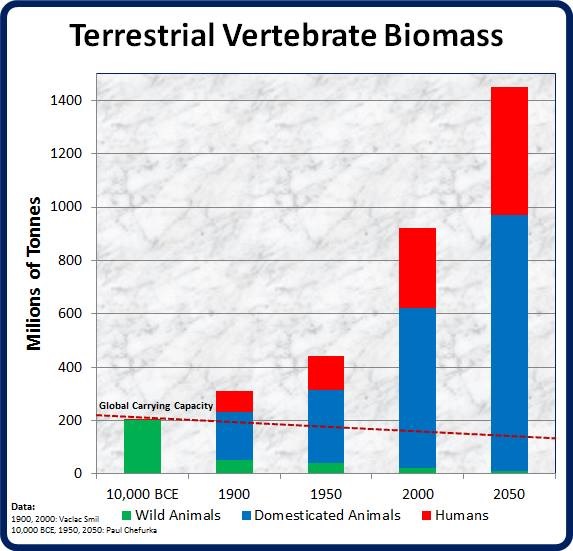
A large fraction of which is livestock (I'd listed nitrogen fertiliser, which I still believe is the largest fossil fuel input). Thankfully, methane's residency in the atmosphere is far shorter than CO2's, though it's a much more powerful greenhouse gas. Global livestock biomass is truly immense, both absolutely and by historical standards:
Genetic engineering of crops may be possible, but we've already transferred a great deal of agricultural primary productivity from survival to caloric activity through the Green Revolution and hybridisation. How much potential remains is ... an interesting question. (See especially Ophuls's ecology texts.)
For heating/cooling, the low-hanging fruit are passive designs, additional insulation, thermal mass, site-appropriate design, limited footprint, limited exposure, increased ventilation in warmer climates especially, as well as district heating / cooling. These can achieve tremendous efficiencies over existing heating/cooling loads.
Again, reading to point: the solvable portion of the problem makes the less-solvable moisture/humidity management at least more tractable.
Smil: He'll be the first to tell you that he doesn't have all the answers, and that BAU isn't sustainable. But he'll do so with copious amounts of extensively-researched, detailed, and soberly-presented facts, addressing much or all of the relevant aspects of the domain. He doesn't just throw his hands up in the air (at least not in public), or castigate his counterparties.
Like Smil, I'm not an optimist. I am a realist, however, which means making realistic assessments of the situation and possible future(s).
Most of those possible futures don't look so hot, frankly. This is like threading a needle, and the tolerances are low.
That accusation is difficult to justify. There are plenty of characteristics of nuclear heat that warrant a look.
* They are not intermittent
* They can directly produce a continuous stream of high-grade heat for industrial processes
* They have very high energy density and don't take up much space or use much raw materials
* Their lifecycle energy return on investment is huge, over 50. Compare with ~8 for wind and ~4 for solar. This matters.
The SMR being dangerous claim is unsubstantiated. Being smaller means they have smaller radiological source terms and are easier to cool. SMRs have been prowling around in our seas for decades with very few radiological accidents. Nuclear in general is orders of magnitude safer than combustion-based energy sources. This sounds wrong but is largely uncontested.
Furthermore, you should check into the sector-size pricing model used in coal, nuclear, and hydro. It shows that as a sector grows, regulations and NIMBY associated with it grows, increasing costs. There are now some indications that costs will increase around wind and solar not for safety or air quality reasons, but due to how much land and raw materials they require.