A fun fact is you can figure out why battleships became obsolete just by comparing Iowa's guns to more modern systems.
A 16", 2,700 pound AP shell from an Iowa class battleship contains 40.9 pound of high explosives as the payload. A 1900 pound HE shell contains 153.6 lbs. of high explosive payload. The AP shell travels at a velocity of 2,425 fps on average. The HE shell travels at a velocity of 2,615 fps on average. An Iowa class ship traditionally stored powder and shells to fire each of its 9 guns 130 times before needing to be re-supplied. The maximum range of the cannon was 24 miles.
By contrast, a Tomahawk cruise missile has a range of 1,550 miles and contains 1,000 pounds of high explosive. An Ohio-class guided missile submarine carries 152 of these on board. A single Ohio-class submarine can put more explosive payload on target than 3 Iowa class battleships firing their entire magazines dry (assuming AP shells), it can unleash its entire devastating salvo in about 2.5 minutes (as contrasted against an hour+ for a battleship), and it can do it from over 64 times the range as the battleship's cannons. Oh also the missiles are guided, and so can actually hit targets at extreme ranges where-as battleship were notoriously inaccurate outside 20 miles. At the Battle of Calabria the battleships on both sides fired a combined total of 335 large caliber shells, to one hit!
Of course the one advantage of the battleship is its shells are travelling on average ~3 times faster than the cruise missile is, and so it's far easier to shoot down a missile than it is a shell. But I hope with the above math you understand why naval planner's response to this was basically "Well if you can shoot down one of my missiles with 50% probability, we'll just fire off 5 at once and we'll still have >95% chance of landing a hit". And unlike with battleship shells, when a single missile hits you you're dead as a dodo - 1000 pounds of HE vs. 40 or 153 pounds for battleship shells.
Even if submarines and airplanes had never been invented, the big gun battleship still would've been rendered obsolete just from missiles alone. Even railguns aren't likely to change this, as we happen to have perfected hypersonic missiles at roughly the same time railguns became practical and HSMs are...I mean basically take all the advantages of a gun, and all the advantages of a missile, and put them into one thing. Hypersonic missiles are amazing/terrifying, and they will be the 'defining weapons' of 21st century naval war.
Also as an aside, can we talk about how damn cool the Ohio class SSGN is?! It's by far the coolest thing the navy currently owns IMO. It can hide in the ocean depths impervious to harm, pop to the surface and fire off 152000 pounds of high explosives, and then retreat to the safety of the ocean darkness again before its enemy even knows what happened. I own a model of it I keep on my desk and it's one of my favorite possessions.
Note: On Los Angeles class submarines the vertical launch tubes can be fired with ~1 second delay per round. So assuming the navy's technology on the Ohio's is still held to the same standard, that's 152 seconds to fire all 152 missiles or 2.5 minutes to fire the whole stock.
>And unlike with battleship shells, when a single missile hits you you're dead as a dodo - 1000 pounds of HE vs. 40 or 153 pounds for battleship shells.
I'm curious if this would be true for a heavily armored target like a battleship, though. AFAIK no modern missile is designed to penetrate ~12 inches of hardened steel armor, as no targets have that kind of armor any more.
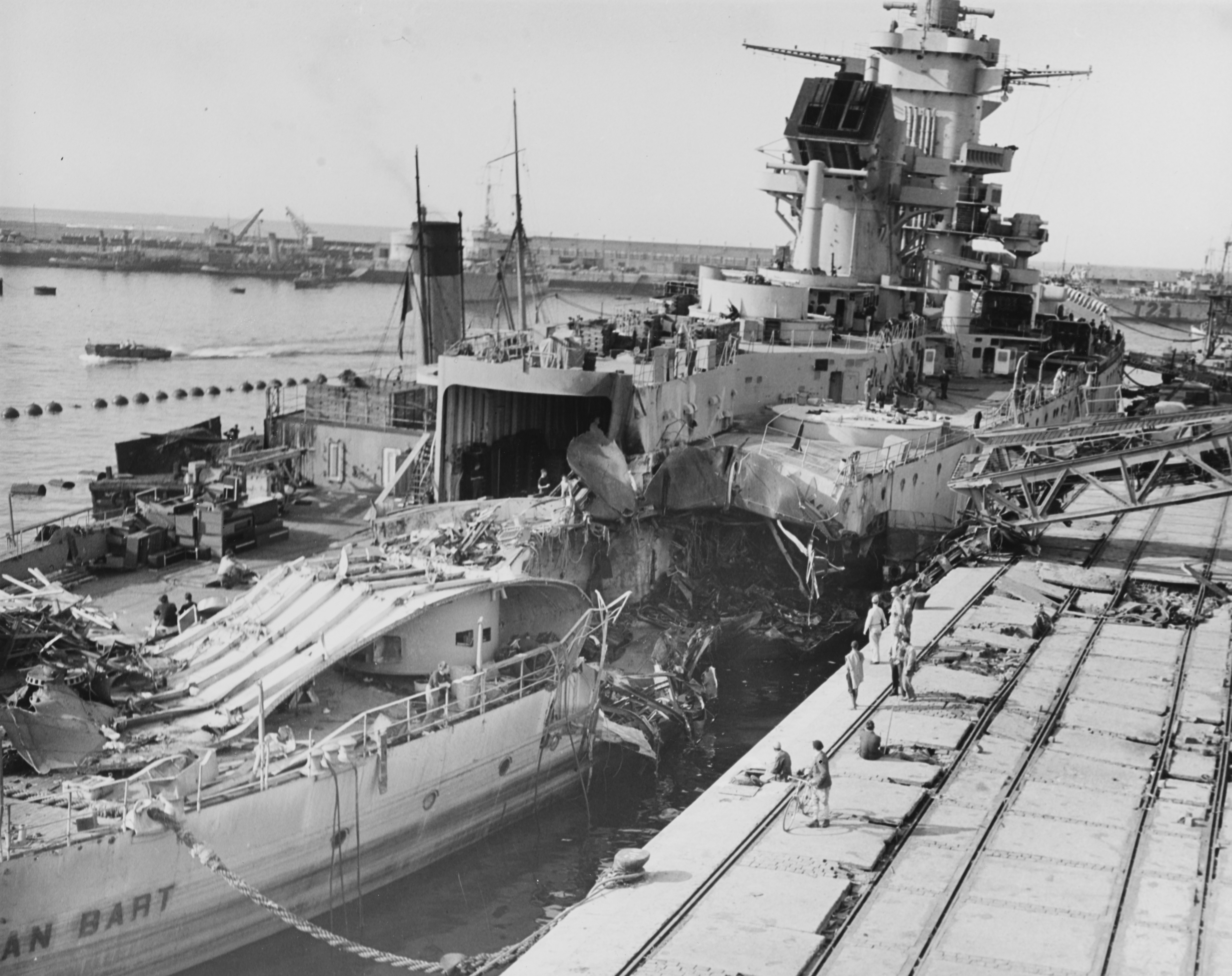
On 10 November 1942 the Vichy French Battleship opened fire on Allied landing vessels in Casablanca after being re-floated following her sinking on 8 November. TBF Avengers were dispatched to deal with her, but they lacked AP bombs and were relying on 1000lb general purpose bombs instead. Jean Bart was struck by one such bomb on her starboard side toward the rear:
The rearward hit would go on to sink the battleship, this time permanently.
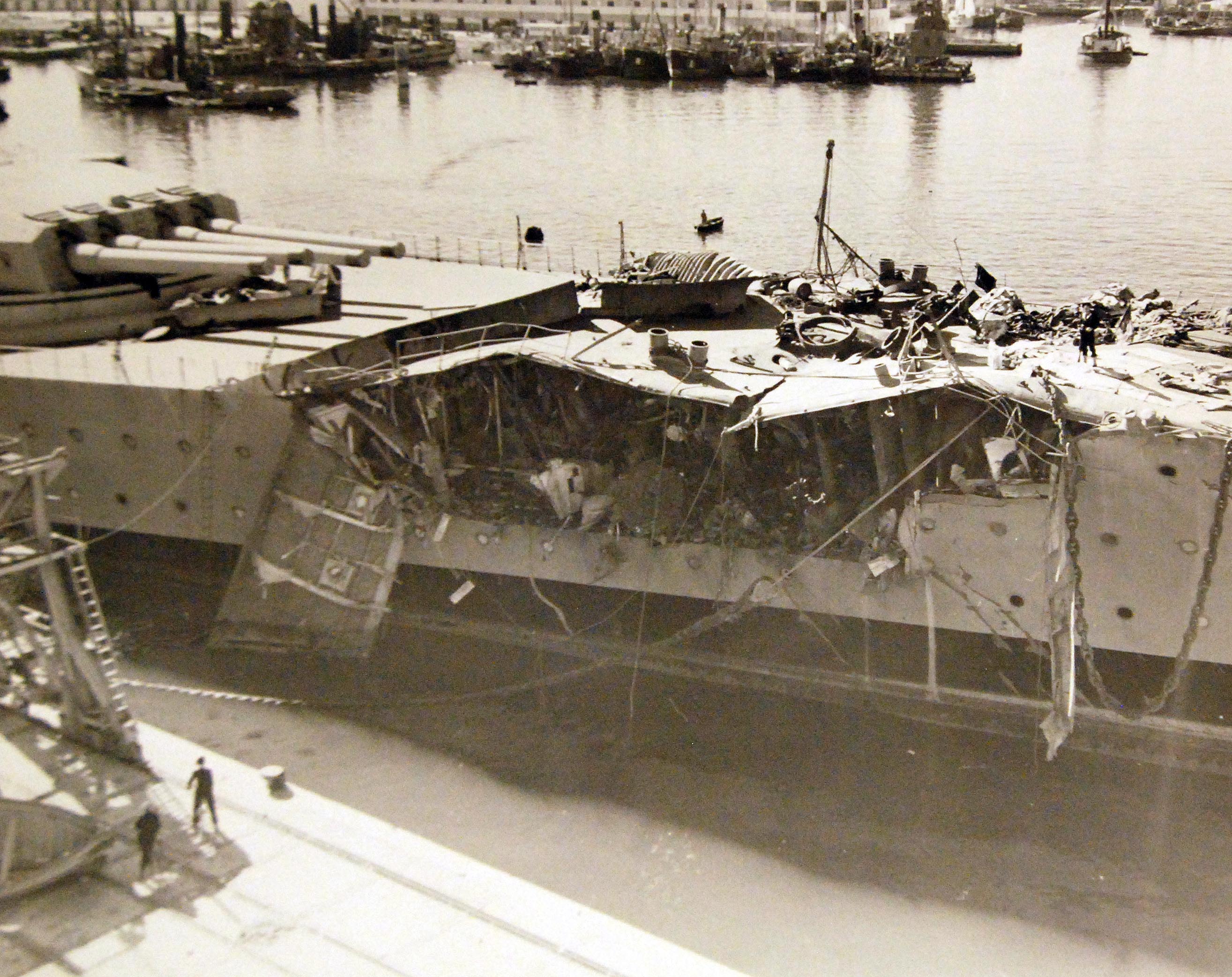
On 22 May 1941 the HMS Warspite was struck by a 500 lb from German bombers, and had her side ripped open and had to immediately steam home least she possibly tear her own guts out. It would take 4 months of repairs before she was ready to be sent back into the fight.
In both instances we're looking at about 1/10th the payload of explosives of a Tomahawk crippling or sinking a well-armored battleship with 1 or 2 lucky hits. The reason is because WW2 battleships employed "all or nothing" armor, where some parts of the ship were extremely well protected (turret, belt) and others had extremely thin armor - which meant even a non-AP bomb could sink a battleship if it was simply big enough boom to rip the ship open in these non-armored areas.
A Tomahawk is guided and carries a very big warhead, so assuming it was programmed to know where the armor on the ship it was fighting had a weak point I wouldn't be surprised if it was able to cripple or kill an Iowa class vessel in just one hit.
Also we do actually have plenty of modern missiles able to penetrate 12 inches of hardened steel armor. The AGM-65 Maverick has penetration against rolled homogeneous steel armor of between 1000 to 1500 mm, or between 40 inches and 60 inches of penetration. It's designed to kill tanks that are using modern composite armor, and needs that level of penetration to do its job. Against simple steel armor, of the kind on a WW2 battleship, it would slice through it like a knife through butter.
Right, but those bombs may have been designed with armor piercing in mind. Battleships' main batteries fired both AP and HE shells, the latter being unable to penetrate heavily armored targets.
I take your point re the Maverick. But you do need to make a big hole in a battleship to actually sink it. To kill a tank you just need to make a small hole and spray the insides.
A 16" AP shell weighs about as much as a Tomahawk and is traveling much faster. Sure, it has a smaller charge, but also a lot more kinetic energy. In fact, the charge itself was irrelevant to the shell's armor piercing capacity, as AP shells were fused to explode after the armor was penetrated.


A 16", 2,700 pound AP shell from an Iowa class battleship contains 40.9 pound of high explosives as the payload. A 1900 pound HE shell contains 153.6 lbs. of high explosive payload. The AP shell travels at a velocity of 2,425 fps on average. The HE shell travels at a velocity of 2,615 fps on average. An Iowa class ship traditionally stored powder and shells to fire each of its 9 guns 130 times before needing to be re-supplied. The maximum range of the cannon was 24 miles.
http://www.navweaps.com/Weapons/WNUS_16-50_mk7.php
By contrast, a Tomahawk cruise missile has a range of 1,550 miles and contains 1,000 pounds of high explosive. An Ohio-class guided missile submarine carries 152 of these on board. A single Ohio-class submarine can put more explosive payload on target than 3 Iowa class battleships firing their entire magazines dry (assuming AP shells), it can unleash its entire devastating salvo in about 2.5 minutes (as contrasted against an hour+ for a battleship), and it can do it from over 64 times the range as the battleship's cannons. Oh also the missiles are guided, and so can actually hit targets at extreme ranges where-as battleship were notoriously inaccurate outside 20 miles. At the Battle of Calabria the battleships on both sides fired a combined total of 335 large caliber shells, to one hit!
Of course the one advantage of the battleship is its shells are travelling on average ~3 times faster than the cruise missile is, and so it's far easier to shoot down a missile than it is a shell. But I hope with the above math you understand why naval planner's response to this was basically "Well if you can shoot down one of my missiles with 50% probability, we'll just fire off 5 at once and we'll still have >95% chance of landing a hit". And unlike with battleship shells, when a single missile hits you you're dead as a dodo - 1000 pounds of HE vs. 40 or 153 pounds for battleship shells.
Even if submarines and airplanes had never been invented, the big gun battleship still would've been rendered obsolete just from missiles alone. Even railguns aren't likely to change this, as we happen to have perfected hypersonic missiles at roughly the same time railguns became practical and HSMs are...I mean basically take all the advantages of a gun, and all the advantages of a missile, and put them into one thing. Hypersonic missiles are amazing/terrifying, and they will be the 'defining weapons' of 21st century naval war.
Also as an aside, can we talk about how damn cool the Ohio class SSGN is?! It's by far the coolest thing the navy currently owns IMO. It can hide in the ocean depths impervious to harm, pop to the surface and fire off 152000 pounds of high explosives, and then retreat to the safety of the ocean darkness again before its enemy even knows what happened. I own a model of it I keep on my desk and it's one of my favorite possessions.
Note: On Los Angeles class submarines the vertical launch tubes can be fired with ~1 second delay per round. So assuming the navy's technology on the Ohio's is still held to the same standard, that's 152 seconds to fire all 152 missiles or 2.5 minutes to fire the whole stock.