IQ is undoubtedly overemphasized by some factions, especially those with an axe to grind and a dog whistle to blow, if it helps them feel less guilty about their position in the world or otherwise rationalizes injustice.
OTOH there's definitely a difference between people, people who aren't mentally defective, people that are quick on the uptake, sharp and alert, who adapt to new mental models. IQ might be an unscientific metric for identifying these people, it might leave some of them unidentified, but they definitely exist. Anyone who's worked with other people, hired other people, had to evaluate other people's capabilities, can be in no doubt about this.
It's hard to separate out Taleb's own axe-grinding from anything concrete he's trying to say about what IQ means as an independent concept. He seems more upset at short-sighted application of thought to first-order problems rather than asking higher-order questions about why the problems are problems in the first place, why the questions are being asked. When I've seen a difference between people in this degree, it's more a matter of personality than intelligence: the more detail-oriented, autistic-spectrum someone is, the more they focus only on the details, and miss out on the bigger picture. It takes a little effort to step back, but I think it can be learned. Whereas IQ (or g) doesn't seem to be improved easily with learning.
The original tweetstorm and this post aim to show something very specific, namely that IQ misses the mark as a measure of intelligence the further away from IQ 70 one ventures. In other words, stupid is stupid, but smart seems to come in many flavors.
The title of the article itself points to this fact, as the word "largely" is inserted. Nassim Nicholas Taleb himself can see the value at the lower levels.
If the goal was to find people that can, say, program, I think IQ works as a perfectly fine metric. If one wants to find someone who can make revolutionary break throughs, possibly less so, but even then, if IQ can exclude 50+% of people, you are onto a good thing.
> The original tweetstorm and this post aim to show something very specific, namely that IQ misses the mark as a measure of intelligence the further away from IQ 70 one ventures. In other words, stupid is stupid, but smart seems to come in many flavors.
Not true. As far as we can tell smarter is better at all levels.
> Beyond the Threshold Hypothesis: Even Among the Gifted and Top Math/Science Graduate Students, Cognitive Abilities, Vocational Interests, and Lifestyle Preferences Matter for Career Choice, Performance, and Persistence
> The assertion that ability differences no longer matter beyond a certain threshold is inaccurate. Among young adolescents in the top 1% of quantitative reasoning ability, individual differences in general cognitive ability level and in specific cognitive ability pattern (that is, the relationships among an individual’s math, verbal, and spatial abilities) lead to differences in educational, occupational, and creative outcomes decades later. Whereas ability level predicts the level of achievement, ability pattern predicts the realm of achievement. Adding information on vocational interests refines prediction of educational and career choices. Finally, lifestyle preferences relevant to career choice, performance, and persistence often change between ages 25 and 35. This change results in sex differences in preferences, which likely have relevance for understanding the underrepresentation of women in careers that demand more than full-time (40 hours per week) commitment.
That is (in part) Nassim Nicholas Taleb's point: we use IQ to select for success, then say IQ is correlated with success. It is circular reasoning.
The more interesting measure is not jobs for which IQ is the main selection criteria to qualify for the training (your examples of MDs, JDs, and PhDs), but things where people create their own impact, lets say entrepreneurs, or world changing ideas (think Naler's Nudge).
I don't necessarily agree with this, BTW. Just linking the ideas back together.
If the SAT test wasn't selective in some meaningful way then people admitted through affirmative action should be expected to do approximately as well as the people that was admitted purely through merit. The outcome says otherwise [1], or if prefer a video [2].
Mismatching people to schools based upon an ideal hurts those people when they come unprepared relative to their peers. Many diverse people admitted through affirmative action with a dream to do the sciences abandon them for other less rigorous disciplines, and it doesn't have to be so if they were matched with a school without the social engineering attempts of ideologues.
Focussing on "affirmative action" feels uncomfortably close to the exact kind of dog whistling this article criticized up front.
As I understand it, most colleges have been using some form of linear regression model on many factors to filter admissions in a way that maximize returns (i.e. alumni donations) for decades now. Surely there is other evidence which shows that if SAT scores were actually a poor heuristic of potential success, schools would have stopped relying on them by now. (without having to bring race into the conversation)
He didn't bring race into the conversation; you did.
Affirmative action is precisely an adjustment of admissions criteria such that ceterus paribus a candidate is more likely to be admitted. Yes, it's based on race, but if it was based on lottery, it would have the same effect: students with lower SAT scores are admitted to schools which otherwise require a certain threshold.
That they don't do as well, shows that the SAT is measuring something relevant to success in education.
Note that affirmative action would have this effect even if average IQ were the same across races, because schools vary in the SAT thresholds they set, and this would have the effect of propelling students into settings they aren't prepared to flourish in.
The article linked (you did actually open that before replying to me, right?) extensively talks about race, and affirmative action is intrinsically linked to it.
Also, I don't know if you're ignorant as to what a dog whistle is, or you're being purposefully obtuse, but "affirmative action" is extremely common talking point among actual racists, because it's a politically acceptable way to disparage racial minorities without directly using the word race; a dog whistle is a term that racists use to make racist commentary that's intended to make it clear to other racists that they're talking about race while still providing plausible deniability (i.e. accusing the other person of being the one to bring up race, when that was the topic from the beginning). "Affirmative action" is an extremely common dog whistle.
So, are you unaware of what a dog whistle is, or are you blowing the whistle?
The problem with "dog whistles" is that they can literally be seen in anything, and are a shortcut to labelling someone a racist without any proof, and therefore not engaging with their actual arguments.
It's particularly interesting in this case because the youtube link is Thomas Sowell speaking about the negative effects of Affirmative Action and he is a black American, would you say that he is dog whistling for racists?
Now onto the law itself, Affirmative Action is a racist policy as it advantages certain races over others, full stop. Recently asian students have brought a suit against Harvard (https://www.npr.org/2018/11/02/660734399/harvard-discriminat...), for their policies negatively effecting asian Americans. As a society we need to decide if we want to advantage some races over others. In my opinion it makes more sense to advantage people from poor backgrounds then it does based on race, as the black son or daughter of rich parents will have had more opportunities than the poor asian American. If you disagree with that I would love to understand why.
In addition, I fully agree that legacy admissions should be removed.
My main issue is that I was accused of "bringing race into the discussion", when it was already very much a part of the topic of the discussion (which you seem to agree). My points and explanation of dog whistles were aimed at that.
I want to be clear that I never accused the parent of being racist (and I don't have reason to believe he was being so). I just expressed that the specific choice of argument felt similar to rhetoric that racists do use, and that supporting it with non-racial evidence instead might better serve the argument. (I admit to also wanting to encourage readers to think critically about a topic so rife with racial tension on both sides)
>As a society we need to decide if we want to advantage some races over others. In my opinion it makes more sense to advantage people from poor backgrounds then it does based on race...
The justification for making it based on race is that it is a form of reparation to the collective racial communities, especially the black community, that have been negatively impacted by a deliberate effort by the government to keep them in a cycle of poverty (black codes, redlining, etc). The other goal is to have a broader ethnic representation in careers requiring a college-education, which is required to effectively remove the inherent internal prejudices in those circles (see also the push for getting women into STEM, and the backlash that they face upon entering due to the lack of women already there to set in-cultural norms).
An unfortunate side effects is that, taking only AA and diversity initiatives into account, a rich black person will have fewer opportunities than a poor Asian American, due to the already high proportion of East Asians in the relevant areas. That's more an issue of the extremely strong disparity of wealth and power in this country than an actual criticism of AA, however. Controlling for wealth, non-Asian POC will still often have fewer opportunities due the the strong influence of networking and in-group prejudice/bias on your career opportunities (which is one of the reasons that AA and diversity initiatives are required)
That being said, I don't know enough about the actual effects of said policies to judge their effectiveness, since I'm not a sociologist and assessing the real results of a policy with such complicated interactions is difficult. I can only speak confidently to the a priori justifications.
Read: I am not saying you are a racist, you just sound like one.
How is that not just a rhetorical trick for calling someone a racist without having to own up to it?
And your point about opportunity is demonstrably false; groups such as Nigerians do better than even Asians in educational and work achievement. There is also a historical african american upper class that consistently achieve in a similar manner across generations [2]. That should be celebrated, not ignored.
Statistically the african american family has fallen apart since the 60s, with 72% of kids growing up without a father up from 16%. The adverse outcomes of fatherless homes on kids is well known [1], and we should ask ourselves why this has become the normal case if we want the outcome of these groups to improve.
By focusing all your scrutiny on racial minorities who you suggest didn't get accepted to college entirely on merit instead of other groups, like legacy admissions, then you could be seen as blowing the racist dog whistle.
As the other person said you are the one bringing up race, not me.
My comment brought up a data set that could be used to evaluate the claim of the article that iq tests are meaningless for what they claim to measure. This data contradicts this claim.
The inclination of social justice believers to treat all people that look the same as a unit is too simplistic, because there is more variance within such groups than between them. It also fits the definition of racism unlike my comment, and saying someone is defined by their skin color is way beyond dog whistle territory.
If you have a rationale supporting your claim use that, because otherwise we can’t engage in productive discourse. I find it unethical when claims of racism like what you use here is used as a bludgeon tool to force others to accept actions or beliefs that are dogma in social justice while evidence shows it hurts those it claims this helps. Especially when those groups are unchosen, and applied by largely upper middle class and above white social justice activists for their political utility.
Data for that is hard to find. Since IQ is at least partially hereditary one would assume that the picture amongst legacy admissions to be at least somewhat different than other forms of social engineering.
That said some people find legacy admissions unfair, but as a person that did not receive that I think it is fine because one of the purposes of any group is to provide advantage to the people in the group. The primary purpose of a long lived entity like an Ivy is to ensure the long term health of the culture that keeps it competitive, which includes providing continuity and a reason to invest for legacy families while also admitting new members from families that can provide mutual value to the entity.
> That is (in part) Nassim Nicholas Taleb's point: we use IQ to select for success, then say IQ is correlated with success. It is circular reasoning.
This would only be correct if the SAT were expressly an IQ test, and we selected people based on SAT score for that reason.
To put it another way, making this point is kind of like selecting for tall players for a basketball team, then saying weight is correlated with fitness to be on a basketball team. That height and weight are correlated doesn't make this circular reasoning.
Yeah totally, or like selecting for confident people where you tell people who score well on the test that they're super confident.
Tall is an absolute, objective measure of a real thing that exists. IQ is NOT a measure of a thing that exists.
Similar effects can be found throwing dice and ascribing the total to an IQ score, then telling parents, teachers what the poor kid's IQ is as though it were their height. It's insane.
I don't understand your concept of something "existing" or not. Do you believe that a "speed" exist ? That a "center of gravity" exists ? That a "temperature" exist ? People who say "IQ is what IQ tests measure" sound to me like they could say "temperature is what thermometers measure". temperature does not "exist" it is molecules movements all the way down, yet it is a meaningful/useful concept. Same goes for IQ or "g factor".
If it is not a real thing, how does it succeed in having an influence over results on a measurement device? Results on cognitive tests have a relatively high test-retest reliability.
Hmm... perhaps. But I'm pretty sure that the questions of e.g. the law exam are about laws, and the questions of medical school exams are about anatomy and medicinal procedures—not about the "which shape completes the pattern" puzzles from IQ tests. I'm quite certain they are not given IQ tests. The SAT, meanwhile, asks math and English questions.
Is Taleb saying that IQ is a bad metric, or is he saying that these other tests are academic and unrealistic, and then referring to them collectively as IQ tests because the results are correlated? Or something else?
IQ tests attempt to measure g, which is some combination of processing speed, capability for abstract thought and working memory, all of those being highly correlated. The GRE and GMAT are just harder versions of the SAT, IQ tests for people who completed middle school. The LSAT is an IQ test with no math portion
> It is designed to assess reading comprehension as well as logical and verbal reasoning proficiency.
The MCAT has one pure IQ test section out of four. However, all of these tests are highly g loaded. People who can do well on one of them can do well on the others with more or less preparation. That’s what g attempts to measure.
"But I'm pretty sure that the questions of e.g. the law exam are about laws"
I don't know about mcat, but no, lsat isn't about that at all. It would be weird testing people for the thing they're trying to be admitted to. If you google 'lsat sample questions', it"s trivial to find what sort of thing is beimg tested for. Which is not 'complete the pattern', but closer to that (I would argue) than to substantive law questions.
Fascinating. I didn't realize that was how law school admission worked.
By "law exam" I actually had in mind "the final exam" and whatever other tests you have to pass in order to not be thrown out of the program, once you're already in. (It seems the "bar exam" is not a prerequisite for a JD, though.) I guess the question is, which is more selective: law school admissions, or "who actually gets their degree once they're in law school"? Looks like the latter filter lets about one third through [1], while the former seems to pass one half if you just divide total admissions by total applications [2], although if we care more about "top law schools" I see various Google results saying it's more like 25%. So... reasonably similar-sized filters. Huh.
I also see an article titled "Law Schools With Low LSAT Medians Have Absurd Academic Attrition Rates" [3]. That would seem to support the notion that the LSAT genuinely is testing ability to do well at law, despite being a non-law exam.
We do? I have never seen IQ used for anything but online wankery. None of my most skilled coworkers have struck me as people outside the bell curve, and we have never had our IQ test results requested, or even measured in most cases.
The SAT, SSAT, GRE, MCAT, LSAT and GMAT are all glorified IQ tests. They’re used for entrance to selective colleges and graduate programmes. Lots of people will be quite happy to tell you where they went to school and what they studied which is the non-vulgar way of signalling your IQ.
Intelligence:Knowns and Unknowns
> are used for many purposes, such as selection, diagnosis, and evaluation. Many of the most widely used tests are not intended to measure intelligence itself but some closely related construct: scholastic aptitude, school achievement, specific abilities, etc. Such tests are es- pecially important for selection purposes. For preparatory school, it's the SSAT; for college, the SAT or ACT; for graduate school, the GRE; for medical school, the MCAT; for law school, the LSAT; for business school, the GMAT. Scores on intelligence-related tests matter, and the stakes can be high.
I scored very well on the GMAT and it’s really testing how diligently you prepare for it, and that is the predictor of success, not the content of the test itself, IMHO.
I’m sure you did improve. Practice effects exist. They’re also limited. Just as I will get faster if I train to run the 100m or run a marathon you can get better at the GMAT, LSAT etc. But there’s a plateau you hit where you can’t get better. If you try to take someone from 50th percentile to 99th on the GMAT in the majority of cases you will fail. An increase of 0.26 standard deviations isn’t nothing but on the GMAT it’s only ~30 points.
Retesting in selection: a meta-analysis of coaching and practice effects for tests of cognitive ability.
Previous studies have indicated that as many as 25% to 50% of applicants in organizational and educational settings are retested with measures of cognitive ability. Researchers have shown that practice effects are found across measurement occasions such that scores improve when these applicants retest. In this study, the authors used meta-analysis to summarize the results of 50 studies of practice effects for tests of cognitive ability. Results from 107 samples and 134,436 participants revealed an adjusted overall effect size of 0.26. Moderator analyses indicated that effects were larger when practice was accompanied by test coaching and when identical forms were used. Additional research is needed to understand the impact of retesting on the validity inferences drawn from test scores.
Yes and no. You can certainly practice GMAT style questions directly and get better at them that way, but the real trick is to meta up a level and see that they follow a pattern, at which point getting a very good score is easy. I think the test is really testing for that (I guess deliberately or why put the pattern in in the first place?). Or maybe it is really testing for the personality type that likes to prepare in advance rather than winging it, that would obviously correlate well with success in any field.
> we use IQ to select for success, then say IQ is correlated with success.
We don’t, though. The most financially successful people in the world are sports stars, movie stars, and business owners, none of whose success has anything to do with IQ scores. He bangs on IQ, but nobody actually uses IQ to select for anything – it’s actually prohibited by law in the US (https://www.britannica.com/event/Griggs-v-Duke-Power-Co). We do use SAT scores to determine admission to college, and SAT scores correlate pretty well with IQ scores, though, so I guess he’s indirectly complaining about SAT scores being used for college admissions? There’s nothing particularly new about this, though – people have complained for eons that measuring people’s test scores only tracks how good they are at taking tests. The problem is, true or not, tests are the only objective way we’ve ever come up with to figure out if somebody actually knows something.
IQ tests (of which there are a ton) are regularly calibrated, internationally comparable (there are some reasonably culturally neutral test protocols) and stable while SAT is a US-only metric.
Maybe SAT is calibrated to correlate with IQ tests?
The SAT is not calibrated to correlate with IQ tests. Being correlated with IQ tests is an unavoidable consequence of what it is. It’s a high stakes test with limited subject matter meant to measure scholastic aptitude. That will unavoidably be highly g loaded. It’s not culture fair, like Raven’s Matrices, because it assumes you speak English at a native level and have been exposed to a middle school curriculum.
It sounds fair to assume some basic skills for admittance, such as a completed middle school competency level and native level proficiency in the language advanced university level material will be taught in. Any person without those will be severely disadvantaged relative to the peers that don’t.
IQ is definitely not a good measure of value, contribution, quality of thought. I think it's probably correlated, and for some contributions may be a gating factor, but I've seen plenty of smart people examining the wrong things, for sure.
Meta-analysis of focus doesn't seem to come free with IQ. I think it's a skill.
IQ is an EXCELLENT measure of "value, contribution, quality of thought". The idea it isn't is weird to me. What IQ fails at is being an ABSOLUTE measure of those things, e.g. John Nash is a genius, but his schizophrenia likely made a lot of what he did and said questionable. Just taking IQ and ignoring other factors would lead you awry. Even then, John Nash came up with the Nash Equilibrium.
I think the mistake is thinking that one measure will be absolutely predictive. Nassim Nicholas Taleb's point is that IQ is a great measure of stupid people, almost absolute at < 70 IQ levels, but as you progress upwards it's predictive power wanes.
Which is GOOD. Success is defined by many parts. Genetics, culture, training, hard work, timing aka luck. That there is no one metric that predicts everything is a good thing. However, while we should be clear on the limits of each of our measures, and not over state their individual value, that is not to say that these metrics are useless.
I think it’s often understated what you say in your last paragraph:
If success has multiple parts with a non-linear relationship (“more than the sum of its parts”), then we’d expect to see decreasing utility for IQ relative to having a strong secondary or tertiary talent — eg, strong leadership skills and EQ, so you can build momentum around your idea. In many senses, this is what we mean by a “well rounded person”.
I’m not sure how that translates into the rant that IQ is useless, pseudoscience, etc. that Mr Taleb makes, though.
Let’s look at height and NBA success. I think most of us agree distance is a measure, but it doesn’t explain NBA success. Just like IQ, it only really explains NBA non-success with much strength: there are very few successful short NBA players, and no midget ones; however, there are many non-NBA playing tall people.
Naively, Mr Taleb seems to be arguing that height isn’t a real measurement because it doesn’t account for basketball skill.
Or, more subtly, once you focus on star basketball players, height ceases to be a useful differentiator. Beyond a certain point, increased height will not lead to increased success at basketball.
> But having no potential is virtually the same as not being able to perform.
That's true, but that refers to people with a low IQ. Thise with average IQ are quite able to outperform people with a high IQ if they have able to put in the legwork or even simply have an opportunity to improve their performance when some with a higher IQ does not.
The old addage that the brain is like a muscle is very orelevant: it makes no difference if a talented athlete does not train, because that only means he js squandering his talent. Meanwhile, least capable athletes that put in the hours do end up improving their performance and eventually outperform more talented athletes.
I would be fascinated to know the IQ scores of all the US presidents, but I assume no such dataset exists.
Being the president would seem to be a good example of a form of success in which IQ would not be that important relative to other personality attributes, like understanding what people want and how to (re)phrase it well, persistence, bravery, being able to spot strategic mistakes of opponents etc. It's not clear any of these attributes would be classically considered "intelligence" in the IQ sense, but they're all clearly valuable for politicians to have.
You can estimate that by looking at their SAT/ACT scores (which are intelligence tests to a large degree) and converting the percentile to IQ norming (mean 100, std dev 15). For Obama you get IQ 130, for George W. Bush 123.
Not to mention, narcissistic sociopaths that rise to high positions of power because of confidence, hubris and taking a cavalier approach on life. Not all of them are genius.
> I think the mistake is thinking that one measure will be absolutely predictive
And I agree. I believe I said that I think IQ isn't an absolutely predictive measure. I didn't say I thought there was one.
Another commenter talks about "taste" being an essential ingredient. That's what I mean about meta-analysis of focus: applying intelligence to the topic of what you're applying intelligence to.
A guy I know—who basically spends his time around high-IQ kids, seems to be on speaking terms with several Fields Medalists, and has closely studied the lives of lots of great scientists and mathematicians—says that great achievement comes from three ingredients: (a) mental horsepower (roughly measured by IQ); (b) taste, an aesthetic sense that helps one decide to work on the right things or investigate the right hypotheses; and (c) obsessiveness, such that when you encounter a project that truly is worth working on, you're likely to spend enormous amounts of time working on it. (The big-5 trait Conscientiousness may be one way of implementing (c).)
Anecdotally, I would very much agree with this, with an added caveat: there are diminishing returns on mental horsepower after 2 stdevs (e.g. 130 iq). After a certain point obsessiveness separates the wheat from the chaff, by very wide margins. The long-game is underrated.
Actually, you don't. It may help to be gifted on all three, but work ethics makes up for any deficit in intellectual potential. For example, MENSA membership does not correlate with intellectual elites in any research field, but you'd be hard pressed to find a leading researcher who doesn't have a strong work ethic.
If you can’t hack calculus you will never be an Engineering professor, likewise close critical reading and an English professor. That puts a floor somewhere between 115 and 120 IQ on becoming a professor at a decent community college no matter how hard you’re willing to work.
I guarantee you MENSA members have higher incomes and educational attainment than non members. I’m equally sure that non-members who are eligible for membership but wouldn’t bother do better because they have better social skills which are helpful for anything.
> If you can’t hack calculus you will never be an Engineering professor, likewise close critical reading and an English professor.
You don't need to score high marks in IQ tests to pass calculus, and there are plenty of fields of research in engineering where a good grasp of calculus is fundamental. Thus, quite obviously you can become an engineering professor eventhough you suck at calculus.
> I guarantee you MENSA members have higher incomes and educational attainment than non members.
Feel free to provide any reference to back your baseless assertion.
82% of American Mensa members have a Bachelor’s or higher. Given that that’s double the rate among the general populace I’m just going to presume they make more money without botering to look it up.
Your comparison is at best skewed. By definition the general populace has on average an IQ of 100. In the US, over 60% of the population has at least some college. The percentage of MENSA members is small. How do MENSA members fare agains the general population with at least some college wrt income?
The fact that this info is not in plain sight nor is even advertised is a clear indicator that the correlation isn't that favourable. In fact, some sources [1] state that the top MENSA eaeners (top 10%) earn over $57k, which is surprisingly low and a fraction of what the average software developer earns (above $100k).
Mensa membership is actually quite interesting, and possibly relevant to this discussion. It's full if people who are 'smart' (i.e., did well on the mensa tests), yet don't do that well professionally to be around smart people all the time. It's full or primary school teachers and nurses and that sort of thing. Mensa is for people who feel out of place in their day to day lives, they're generally not well understood by their day to day environment. While (most) doctors and lawyers and engineers and academics are already around smart people all the time, and don't need any extra on top of it.
(All this imo, may be observation bias, ymmv, etc)
1) why people desire to actually become a member of Mensa in the first place
2) the population of people who are eligible for membership (2% of the whole population) yet are not members.
On cursory inspection it would seem if you just talked about the top 2% of the distribution you would likely get a different answer than if you just talked about the people who felt the need to self- select into the MENSA organization.
Ok, so what about the selection bias itself? What would drive you to join MENSA? If you were already "accomplished" to some degree that you felt satisfied with why would you necessarily feel the need to say "I'm in the smart people club". Yes, you've already visibly demonstrated that. So what if you haven't demonstrated that but you find everyone around you mildly maddening to deal with because they just don't get it. Well... you might be inclined to join the smart people club and find some interesting people to hang out with.
I "joined" the mensa shortly after I finished college (masters degree), moved in with my girlfriend and started freelancing. I always thought of myself as having high IQ but I was never formally tested before. I felt that I will no longer be intelectually challenged in my daily life anymore and I will never know if I'm intelligent or not. My aunt was recenly getting into police force and she had IQ test as a part of her recruitment. She had a book of IQ tests I borrowed and went through, in preparation of mensa exam. Mensa test was very easy. There was a lot of time. I solved every question then double checked every question, then triple checked, then finished with half an hour left. I made no mistakes. I left the test with the opinion that every programmer should do it because it's easy morale boost and if you ever done anything with bitwise operations and frame by frame animation, right solutions for some of the questions will be so easy for you.
Results came, I made no mistakes. I got it. Got my plastic membership card (with mistakes on it), email address, mailing list membership and yearly subscription for amateurish mensa paper mag sent to wrong address (same mistake as on the plastic card).
Mag was random (somehow it was finding way to me despite the wrong address), mailing list was random. I did not pay membership fee for second year and that was pretty much it.
I never sought any connection with my "fellow mensans" and felt no connection to them. I came just for the test to validate myself.
My mensa membership was useful for me once. After few years my gf started treating me like an idiot because I didn't immediately knew what she had in mind when she was saying something and was infuriated when I asked questions trying to figure it out.
I said something to the effect "You are treating me like an idiot, when I know for a fact that I'm not one. If I didn't know, at this point I'd be devastated and convinced by your behavior that I am, so please stop behaving like that." ... and she stopped.
She was later diagnosed with brain tumor, so her behavior might have been influenced by that and I don't know if she would be able to stop herself without solid evidence in the form of my mensa membership.
The fact you had some frame of reference you could use to reason about who was likely right or wrong in the given situation is interesting. I don't need an IQ test or to join MENSA to figure that out but it did take reading about about 10 or so books on politics, philosophy and psychology to figure out "everyones thought process is extremely busted, some more so than others".
Otherwise how the hell do you even get that frame of reference?
People in general have very little understanding how they're more or less a murderous political machine running a large set of very low resolution models on garbage in, garbage out.
If you don't understand that then you have very little recourse on breaking out of an unhelpful program or loop you might be stuck in. Even if you know that, it's still very challenging to break out sometimes.
I'm thinking to get an IQ test lately out of curiosity. Ive known some people personally who I reckon I just can't touch intellectually... like I can feel the difference when I talk to them. So, I've never really thought I was highly intelligent, but I'm starting to get the feeling perhaps I'm not smack bang in the middle of the distribution either. Deeply curious to find out.
It seems like it boils down to IQ, trait conscientiousness and the randomness inherently present in a complex, dynamical system.
I think people understimate or ignore the randomness aspect because you can't measure the way in which it contributes. But it's such an important factor. Randomness can generate circumstances that push and pull people at all ends of the distribution in all different directions. That not a trivial thing.
The detractors seem to want to focus on "well it's not a perfect predictor". Right. And you're not going to get one in a complex, dynamical system such as this.
But in case you were looking for some model that paints a roughly accurate picture in broad strokes, here's one we prepared earlier.
Obsessiveness only helps if you're headed in the right direction. That's why YCombinator starts up startups with so little capital - so if they're headed in the wrong direction, they find out fast.
His own argument is bust in that in that success and failure are themselves asymetric, so it's a moot point.
"Failing" or "not succeeding" is the default and anyone can do it. In fact, the majority of people will never "make it" and most people even who do semi-well will live comfortable but not amazing lives.
"Success" which he seems to judge as perhaps being a somebody or doing something notable follows a power law distribution. It's rare.
Ok, so most people work the 9-5. And what does Taleb have to say about that? He says "ok, well, yes, if you're a slave then IQ seem to predict you'll do better in that particular game". Right. So it is a good predictor of how well you can expect someone to do when they play the game that the vast majority of people play.
So... In other words it's roughly speaking useful.
Don't even get me started on on his term IYI (intellectuals-yet-idiots). Implying that there are people who are intellectuals that suffer no bounds to their rationality nor any partisan or ideological bias. Right. Only an IYI could even come up with such a concept. I see this all the time. Disagree with someone in academia? Oh, well they are a pseudo- intellectual! Or perhaps you might consider the alternative that you just used pseudo-reasoning to reach your psuedo-conclusion.
He draws an analogy between "best measure" proponents and "Value at Risk" proponents.
Ok. Well let's lay out the tools that will help us analyse that analogy. In the book Shortcut John Pollack describes the 5 things that characterize an effective analogy.
1) uses the familiar to explain the unfamiliar
2) highlights similarities while obscuring differences
3) identifies a useful abstraction
4) tells a coherent story
5) resonates emotionally
It certainly resonates emotionally if you accept the premise that it tells a coherent story. It certainly tells a coherent story that relying on a bust metric will catastrophicly blow up in your face if you accept the premise that it identifies a useful abstraction. It identifies a useful abstraction that a metric might not actually be measuring anything real if you accept the similarities and don't look at the differences.
I'm not part of the finance world and don't have a good enough grasp to deconstruct the analogy enough to figure what the differences are and whether it is a good or a bad analogy, but I wanted to lay out the tools to help people do so.
My gut says thats not a good analogy. If only because people say that well it seems to be the best measure we have and he says that's what the VaR guys said. But then he also says, well yeah if you're talking about the domain in which the majority of people spend the the majority of their lives (the workplace) then yes, it does actually seem to have some predictive power there.
The frustrating thing from the perspective of an individual differences researcher is that Taleb is not at all correct about IQ becoming less predictive of performance at higher levels! Studies pretty consistently show that IQ is a valid predictor of performance all the way up the scale, so that, for example, someone with an IQ of 145 is likely to perform (at school, on the job, etc) better than someone with an IQ of 135. Here's one good reference, but you can easily find many others: https://www.jstor.org/stable/41038598?seq=1#page_scan_tab_co...
Taleb just seems to make the (incorrect) assumption that IQ is less predictive of performance at the high end--without any evidence--and then builds an extended diatribe on top of that falsehood. This thread is evidence of the damage that someone with very little domain knowledge, very high self-assuredness, and a far-reaching voice can do to the factual basis of public discourse.
I just can't get over how misleading it all is. He just made up those figures at the bottom of the article--they aren't based on any actual data at all!
I'm as surprised as you and I'm glad someone took the time to write that up (I was about to when I saw your comment). I don't understand why someone would call IQ "unscientific" without addressing research showing it to be a good predictor of future performance. Note that this still doesn't invalidate the point that people can be smart in many different ways (yet have the same IQ), which seems like a reasonable position.
Just because something is a good predictor doesn't make it scientific. There could be a third variable like wealth which needs to be controlled for, but is rarely done in those studies with few exceptions.
In those exceptions, it was generally found that wealth of parents played a much bigger role in future success than IQ.
> Just because something is a good predictor doesn't make it scientific
Perhaps, but Taleb’s charge of it being nonscientific is based on it not being a good predictor of success except at the low end, from which he concludes it is not a valid measure of intelligence. This is wrong both on the facts (it is a good predictor across the board), and the underlying logic (intelligence and propensity to succeed are two different things, while it turns out that IQ is a good predictor of the latter, that actually is not logically necessary for it to be a good measure of the former.)
> There could be a third variable like wealth which needs to be controlled for, but is rarely done in those studies with few exceptions.
I've read lots of studies of the relationship of intelligence to various success measures, and controlling for other variables (especially various socioeconomic ones) is the norm, not an exception.
> In those exceptions, it was generally found that wealth of parents played a much bigger role in future success than IQ.
While that's true for some success measures (for a number, parental educational attainment is actually a better predcitor than parental wealth, which mostly seems to be a predictor as an imperfect proxy for parental educational attainment), that doesn't invalidate IQ as a scientific measure of intelligence or intelligence as a factor in success, since the intelligence as measured by IQ predicts variation not explained by parental wealth. Your argument is like trying to invalidate a measure of speed because it is a worse predictor of winning a race than which starting line a contestant is allowed to use.
To be scientific would require proving a definite causal relationship between IQ and intelligence, while also convincingly proving that intelligence can be measured with a number
Why does it have to be causal? A variable can be a real predictor of another without any of them causing the other one (for instance, they may have a common cause). That doesn't mean the predictor is of any less value.
I would say that results on certain cognitive ability tests (i.e. "IQ tests") being at least a moderately good predictor for future performance in certain human activities is a rather well proven fact. For instance, the correlation between an IQ score and future job performance on a job with complex requirements is about 0.5.
Of course, that does not mean the relationship is 1-to-1 and that it is a perfect predictor (which it obviously isn't).
> To be scientific would require proving a definite causal relationship between IQ and intelligence
That's not how science works. A scientific theory includes a hypothesis with a causal explanation, but science doesn't deal in “definite causal relationships”, but in empirically useful models which only get viewed as approximating definite causal relations with age and lack of a better (simpler and/or with broader explanatory power) model being discovered.
IQ is one of those topics which is, unfortunately, inescapably political. If important psychometric traits, like intelligence and personality, are highly heritable, then one of the implicit assumptions of left-leaning points of view is undermined: that everyone is inherently equal, that anyone can achieve anything given the right education, environment and resources.
Add to this the fact that we know that other heritable traits may be ethnically distributed, and we have a particularly difficult thesis.
The solution to this for some, is that IQ cannot be allowed to be meaningful, as the idea is simply too dangerous. The article above and much of this discussion are the result.
Simply put, this is a battle of ideology masquerading as a debate over a matter of fact. This is not the kind of discourse you would get if people were discussing the precise atomic weight of hydrogen.
you are being downvoted but what you are describing is unfortunately exactly what is going on.
There is that political push to pretend everyone is exactly equal. Following that doctrine, Every difference would only be to blame on your environment.
Over the last couple years, this trend is going over well established scientific proofs. That ideology is getting very dangerous and I think we are getting into a dark age of science for those controversial subjects where political correctness and playing nice will be seen as more important than scientific proofs.
You’re painting a picture that every social justice-aware person is pushing for equality, while ignoring calls for equity and how that’s distinctly different.
Can you share what "equity" means in the context of social justice?
Over the years I have tried to understand what "equity" means. I have been unable to comprehend "equity", despite reading many articles and definitions and listening to many discussions, I do not understand what "equity" is.
The leftist position isn't that everyone is inherently equal but that everyone should be valued equally and afforded equal opportunity regardless of their race/gender/ability. The idea of an "IQ" measure is too close to the idea of measuring inherent value, which shouldn't be contingent on things like how much nutrition you had as a child. Furthermore, the idea of "IQ" could be considered dangerous because it often serves to mask the harmful biases that actually inform our impressions of people.
The left uses any inequality of outcome, like the unequal representation of minorities and women in the software development industry, as evidence of discrimination without allowing for the possibility these differences are due to different abilities, choices, or desires.
And if anyone challenges the belief that all outcomes should be equal, they retreat behind the very different argument you've just made, which nearly everyone agrees with.
> The left uses any inequality of outcome, like the unequal representation of minorities and women in the software development industry, as evidence of discrimination without allowing for the possibility these differences are due to different abilities, choices, or desires.
No, the left doesn't. On a number of levels; as well as not ruling out the possibility of non-discriminatory causes (while being skeptical of handwaves in that direction), the left broadly recognizes that differences in choices and desires are natural and obvious consequences of visible discrimination in society, and thus even when they are direct factors not inconsistent with discrimination as root cause.
I'm as skeptical as you are of "handwaves", and I'd like to see definitive research into this very important topic. Government intervention should be based on proof, not skepticism or bias.
But the left won't allow research or even discussion of the topic, so we don't know whether IQ, for example, is actually a cause of the unequal outcome in software development.
Merely discussing the greater male variability hypothesis is enough to cause research to be disappeared. [1]
And suggesting that IQ may be unequal between groups is enough to end careers.
Greater male variability isn't a hypothesis, is it? It's clear in the data from longitudinal IQ studies, or so I thought. It's more a fact than a hypothesis.
Hold on, I'm a lefty - and don't particularly like that brush you're tarring me with.
Now before we go on, I do agree with some of your points. The results we observe are driven by many factors and individual choice is one of them. I object to 'positive discrimination' and the like as it's personally unfair.
However, I do have that deep troubling feeling that there is bias all over the place. I'll just go with gender, as you mentioned it (and yes, this is all anecdotal).
I'm in the UK, working for an Israeli company. The UK office (and US) is a veritable 'sausage-fest' - however Israel and India have a far higher proportion of women doing these technical roles. My point is that these "personal desires" seem to vary by geography, rather than gender.
Now, why would this matter, if everybody gets to do what they want?
Well, income. Many western industries seem to have massive gender bias within them - and women always seem to end up in the ones that pay less (which for want of a better metric is our best indicator of 'value' we have).
Now within a job role, once you balance in hours worked/flexibility/anything-you-care to include the gender pay gap isn't too bad. It's there, but not enough to annoy me.
My quibble is that if you/I had two children, one male, one female, equal in every way - the male child is going to earn more.
Lets imagine you do a human study that measure the incentives and disincentives of seeking high income job, based on gender. What would the results be?
How does society treat men who do not prioritize work income in life vs men who prioritize work income over other aspects in life.
How does society treat women who prioritize other aspect of life over work income vs women who prioritize work income?
After measuring that and how high the amplitude is, we can rather easily see the building blocks of the pay gap.
To take a bit of data from Sweden, a man who is in the bottom 50% of the income pool has less than half the probability of having children of his own. Increased income has a very strong correlation with fathering children. For women this is the opposite with fewer children at higher income, but the amplitude is significant smaller than for men. The difference in children between high income and low income women exist but is comparable small.
If we could align those incentives so they point in the same direction and with the same amplitude then those two children, one male, one female, would likely end up with the same income later in life.
That's another area that merits research beyond simply assuming that an unequal outcome implies discrimination, and research to-date isn't entirely supportive of that assumption:
> A massive study that looks worldwide at how national wealth and gender equality affect the choices men and women make ... found greater national wealth and gender equality are tied to bigger differences in preferences between men and women.
Believing that all humans are equal and any differences in outcome is the result of discrimination is a caracature of leftist views akin to labelling conservatives "just people out to screw over the poor".
My observation is that the biggest chasm between left and right is the burden of proof for discrimination. The left believes discrimination is the basic human condition and one must prove that a decision or process is fair, or else it is biased by default. The right believes discrimination is an abberation, much like crime, and guilt must be proven, not presumed.
Notably, under the left's view, believing a system is just would require proving a negative.
Is basically 'guilty until proven innocent'; a recipe for eternal identitarian strife; totally different from how we approach structurally similar questions on other topics.
I'd agree with the OP - I'd never thought about it like that before.
My addition to the theory would be that left & right look identify the issue from different perspectives.
e.g. You can look at the planet as whole today, and see there are massive disparities - then try to drill down and work out how to fix it holistically.
Or, you can look at those immediately around you, sort that out, and hope that all people do this and it will ultimately ripple up.
Well, the leftist position is that everyone is equally capable of producing economic value beneficial to the collective state, and should be given those opportunities to do that.
The left is a spectrum, there are left leaning people, and people who would like to see communism implemented in the United States. For left leaning people, center, and right leaning people equality of opportunity is desirable and will maximize scientific progress, abundance, and quality of life.
What far left people want is equity, which is vastly different and is equality of outcome. They view the world in a very black and white lens in which any endeavor/business/group which doesn't perfectly match population distributions must be inherently racist/sexist/etc because there aren't any differences or preferences between any groups.
I’m not sure what this has to do with leftists, as the idea that Taleb is a leftist is absolutely risible. He’s a reactionary egomaniac who thinks all of his ideas are correct simply because they are HIS ideas, and obviously HE can never be wrong
I never mentioned leftists, I said words to the effect of assuming a blank slate is one of the implicit assumptions of left-leaning world views. Taleb can share such a belief without explicitly being on the left.
I think you may be confusing the assumption that people are equal (blank slate) with treating people equally (not misapplying aggregate statistics to individuals and not being an asshole). The latter doesn't require the former. Some leftists might argue for a blank slate but I'm not even sure this is the majority view.
I had a discussion on this topic a while ago, and IMO a reasonable stance to take could be that, yeah, there might be some congenital differences among people in terms of their abilities to perform certain tasks. However, this doesn't mean that people should be treated way too differently just based on that factor.
Isn't the ultimate left-wing dream "everybody doing whatever they enjoy/are good at, but treated absolutely equally"? Obviously we can't really be there yet due to a limitation on the total amount of available resources, and we do have to reward people more who hold important positions and make big impacts. However the point is if somebody is born without that much resources/luck/congenital abilities or whatnot, it's not their fault and they should still be totally respected and well treated. That could be a more sensible way to approach this instead of being absolutist.
Also I still believe that luck and resources far outstrip so-called "raw talent" in the vast majority of cases/jobs, unless you are to be Usain Bolt or something. So the importance of IQ or not doesn't really change their point that much.
You could also say it undermines a major tenant of right wing politics too: that wealth is earned. If your wealth results from a genetic lotto ticket, you didn't earn anything. You just got lucky. This could be an argument for wealth redistribution.
If true, strong heritability of ability could undermine much of present day politics.
Potentially, but you would need to define what is meant by earning. Is earning defined by subjective difficulty? Is ability already part of the concept of earning, such that what we find virtuous about earning is in part the capacity to do a thing?
There is also a more fundamental difference between the two propositions, the first is empirically measurable: people have the same or broadly similar potential, or they do not. The second is a value judgement regarding who deserves what, which is ultimately a moral or aesthetic matter. This seems to me somehow more difficult to decide upon and somewhat weaker in its force.
(I upvoted you by the way because I think that’s an interesting point)
I made that argument largely to show the versatility of sophistry. You can take a proposed fact, like strong heritability of ability, and weave many arguments around it.
I have in fact heard people argue for strong socialism on the basis of heritable inequality. This would assume the definition of "earn" as to acquire through individual goal directed action. If most of the ability behind that action was not itself acquired through anything but luck, then this could undermine the notion of a moral claim to outcome.
>The frustrating thing from the perspective of an individual differences researcher is that Taleb is not at all correct about IQ becoming less predictive of performance at higher levels! Studies pretty consistently show that IQ is a valid predictor of performance all the way up the scale, so that, for example, someone with an IQ of 145 is likely to perform (at school, on the job, etc) better than someone with an IQ of 135
He has already addressed that point early on:
"If you renamed IQ , from “Intelligent Quotient” to FQ “Functionary Quotient” or SQ “Salaryperson Quotient”, then some of the stuff will be true."
That's not really addressing the point, is it. IQ correlates well with measures of performance. Taleb's point, if we are to generously interpret his screed, is that some classes of valuable mental performance are very hard to generate metrics for or even define at all, and therefore, you would expect them to correlate with IQ less or not at all.
For instance the chart that claims IQ correlates well with military performance and poorly with "creativity". But how is creativity being measured? It's going to be far easier to measure the performance of a soldier than a creative person, the latter isn't even a clearly defined category, lots of people consider themselves to be creative but generate unpopular dirge. So all he's doing here is dissing people whose performance is more easily measured by nature of their job.
I have to admit the article annoyed me. I actually did believe him when he said IQ doesn't correlate at the upper reaches - I have even studied psychology but it was a long time ago, and wondered if my knowledge was just out of date or forgotten. So I'm glad I read these comments and learned that it's not the case. But it mostly annoyed me because I thought it would be an interesting addition to the ongoing story around poor replication rates and practices in some branches of science. But it seems actually to be some sort of political article targeting conservatives. Even with the wrong parts of his article, I do agree with some of his overall points, but when I got to the end and saw it was tagged "Racism" and "Alt-Right" rather than science related terms, I realised I'd been reading a bog standard rant of the sort that might appear in the Guardian or Vice - just dressed up in a scientific and haughty tone, to make it sound authoritative.
The problem with his overall point is that whilst yes, an observer of history might have wondered how Britain went from primitive tribes conquered by the Romans, at the outskirts of known civilisation, to owner of the largest empire the world has ever seen, that was over a very time long period and the average Roman person would have been quite right to stereotype the population of the north at that time - the changes that invalidated those stereotypes took place over far longer than a human lifetime. People using IQ scores to measure certain types of performance today would be entirely valid to do despite the correlation with race, if they were looking for workers whose performance does correlate with IQ. The fact that not all categories of valuable work may be measurable or correlate doesn't detract from that fact.
>is that some classes of valuable mental performance are very hard to generate metrics for or even define at all, and therefore, you would expect them to correlate with IQ less or not at all.
I think the crux of Taleb's point is that the kind of mental performance IQ is a useful metric for is not valuable (including the associated jobs and roles that go with it).
> I think the crux of Taleb's point is that the kind of mental performance IQ is a useful metric for is not valuable
Yes, the most generous interpretation of Taleb’s screed is that its not really (despite it's express wording) a criticism of IQ as a measure of intelligence but of the value or intelligence beyond a certain level compared to other aspects of personality.
Which is probably a broadly more sensible claim on a general level (though his specific claims about IQ as a success predictor remain wrong.)
But that's a fairly generous interpretation of his claims that requires an equally ungenerous interpretation of either his writing ability or his character (because if it is intentionally written as misleadingly as that would require, it's got to be a deliberate effort to produce exaggerated controversy.)
Taleb is using the idea that in order to create a world where, barring extreme circumstances, such as birth defects and disease, people are of roughly equal ability we have to pretend that, baring extreme circumstances, all people are of roughly equal ability and attack any information that points out anything to the contrary. The idea being that by believing a reality is true and attacking anything that contradicts that belief we can make it true.
Yeah I missed this HN; it's in my area of expertise.
I don't mean to be hostile, but I don't know how else to say it: I don't know why or how posts like this, and most of what Taleb posts, get this much attention, because they're so ironically unscientific and poorly written. Taleb doesn't know what he's talking about, he selectively cites research, and makes assertions as if they are citations. The citation you provide is one example; there are scientists (e.g., Lubinski) who have successfully demonstrated over the course of years of research the validity of scores on the upper end of the intelligence distribution. Taleb comes across as an uninformed idiot.
Taleb falls into these common fallacy traps regarding intelligence and individual differences research:
1. Some improper use of intelligence theory historically (e.g., racist, overapplication) doesn't mean the idea of intelligence is invalid or not useful.
2. A trait such as intelligence can be highly but not perfectly stable; environment can contribute to stability and genetic factors can contribute to changes.
3. Measures can be imperfect but still useful and valid, throughout the range.
4. The contribution of other factors to outcomes other than intelligence doesn't mean general intelligence isn't contributing as well.
5. The phenomenon of general intelligence doesn't preclude the existence of more specific ways of describing cognitive abilities (e.g., verbal memory, processing speed, visual mental simulation).
Someone else posted something about how political IQ and individual differences research is. I feel about these topics how I imagine ecologists must feel about global warming research: lots of gish gallop by people who have a political or narcissistic axe to grind.
Another problem is that people want to believe that problems in behavioral sciences can be reduced to really simple black or white positions, or apply analogies from other fields directly without any modification. Yes, you can measure behavioral attributes, but no it's not quite ordinal and not quite ratio, and that's fine. Yes things can be somewhat stable and somewhat not. The list goes on and on.
Finally, there's this narcissistic status-asserting behavior that drives a lot of this. It's like the pecking order in science that goes something like physics > chemistry > biology > behavioral science is driven in part by people feeling the need to assert that they're smarter than people lower in the hierarchy. The problem is that this hierarchy is basically wrong, and driven in part by the system complexity of the fields, but it doesn't stop people like Taleb because he needs someone to bully to make himself look smarter.
He addresses that, the issue is that you aren't identifying "performance" but rather "performance in the sort of test taking environment that exists at school".
His entire point is that, while IQ may identify good, obedient candidates for BS jobs, it is not broadly applicable as anything like a general metric for life.
Does anyone use it like that though? Isn't he arguing with a straw man? Who is using IQ to allocate funding to pop singers? IQ scores aren't used that much and only ever for predicting success of jobs where success is easily measurable (which is what Taleb seems to mean by "obediency-based BS jobs").
Yeah they do, I've seen https://www.worlddata.info/iq-by-country.php linked in discussions about if Germany should welcome refuges from Africa for example. And the gist was that while getting Asian high achievers is a net win for the country, letting refuges from Africa is, because of the linked map, a loss for the country.
Given that not even Taleb disputes IQ effectiveness on the left-end of the spectrum, meaning the low end, letting waves of refugees in from sub-saharan Africa (average IQ below 70 [1][2]) would definitely be a net loss for a first-world country.
His first sentence in linked article starts with: '“IQ” is a stale test meant to measure mental capacity but in fact mostly measures extreme unintelligence'. Why would any developed country want hordes of "extremely unintelligent" immigrants?
Which is why there exist countries with extremely harsh immigration policies that are first-order eugenic. Singapore is one of them.
> Studies pretty consistently show that IQ is a valid predictor of performance all the way up the scale, so that, for example, someone with an IQ of 145 is likely to perform (at school, on the job, etc) better than someone with an IQ of 135.
To be fair, he doesn’t say that high IQ are not correlated with high performance, he conjectures that they ‘decorelate’, by which I presume he means the correlation weakens. (It’s pretty obvious at the end of the post that he’s arguing that).
If true, that is concerning for a measure. Heteroscedasticity is a serious problem for accurate prediction - in particular it tends to conceal the inaccuracies of predictions.
He also points out other issues, non-monotinicity and intransitivity which would be problematic. If your measure predicts candidate A is better than B and candidate B is better than C, you generally want it to predict candidate A is better than C. If it predicts candidate C is better than A, it creates confusion.
I'll admit I spend probably greater than average time brooding over how dumb most people are. But I don't think this is inherent in those people. I think it's mostly a result of their prior knowledge, sleep, energy level, stress/anxiety, and give-a-shit. I think most people are fundamentally capable of great intelligence.
Longitudinal studies in this area (developmental effects on intelligence) are vanishingly rare. Those that do exist are either extremely limited, ethically suspect, or useless (confounded).
The difficulty in answering "why is person/are people the way they are?" in a rigorous, falsifiable way has brought about the existence of entire disciplines dedicated to qualitative analysis as a means of getting closer to answers without requiring often-impossible rigor.
I think "falsifiable" might be too high a bar for answering these kinds of questions. That doesn't mean we should give up, or presume the null hypothesis: getting to "probable/improbable" in a useful proportion of cases is likely the best we can do.
There are natural longitudinal experiments in the form of twin studies. They show pretty conclusively that the largest systematic influence of intelligence is DNA at about 50%. Almost everything else about intelligence is due to random variation in the environment (and not due to all of the things you would think make a difference, like parenting, schooling, class size, economic status, etc.).
The person I was responding to could also just go talk to a bunch of teachers.
> I think most people are fundamentally capable of great intelligence.
If the real world distribution of IQ closely approximates the Gaussian distribution IQ tests are meant to model, then in the US alone there are about 44 million people in the range from about 70-85. World wide, about 1 billion people in that cohort of 1-2 standard deviations. Even if actual real world results are half of what the models predict, we're still talking really large numbers of people.
Finding ways to bring them up to "just" average intelligence would be astounding for the species, and I'd aim for that first instead of setting ourselves up for failure by defining a goal of "great intelligence".
Right now, the best we can prescribe with even a semblance of consistent results is intensive educational intervention and family assistance from early childhood onward. Actually doing that in our current economic model would be on the order of ditching the MIC and somehow transferring the spending to those activities. That's a pipe dream with current established stakeholders.
Malnutrition only has effect on intelligence at extreme levels that basically never occur in the US. The American poor sometimes go hungry, but are never actually starving, and don’t lack micronutrients either. Don’t get me wrong, terrible food and atrocious eating habits, resulting in serious health problems, are one of the most serious problems in this country. However, this doesn’t impact intelligence.
I have six years of college. I was in all the gifted programs and so forth in school. I was one of the top students of my graduating high school class.
Then I ended up very ill and homeless.
My comments in online forums during that time were filled with typos and tended to sound like an idiot wrote them.
I've gradually gotten healthier. My typos and other issues have gone way down.
There are a lot of Americans living with various sorts of chronic health issues.
So, in short, I don't agree. But I'm probably not up for trying to "prove it" and just contemplating the possibility makes me feel tired and aggravated.
Honestly, at this point we should just focus on getting to genetically engineered solution. It’s really not that far away at this point. All the environment based solutions have extremely small effect sizes and are really expensive.
> energy level, stress/anxiety, and give-a-shit. I think most people are fundamentally capable of great intelligence.
This sounds like there's a missing link where "most people are fundamentally capable of higher energy level, less anxiety, more give-a-shit" may not be taken for granted.
High energy and low anxiety seem more trainable than IQ, although even then they aren't infinitely trainable. Thomas Edison, by the common accounts, slept four or five hours a night plus a few short naps; most people couldn't do that.
There are some other important factors that aren't as flattering to modern Western society. I know some smart people who are stuck in dead-end jobs because their parents didn't know the right hoops to jump through to get them into an environment conducive to socioeconomic advancement and a good college, and some who aren't going anywhere because they just can't buy into the BS they're supposed to buy into. If you can't suck it up and agree with your professors, even when they're obviously wrong, you're going to have a hard time.
On the other hand, I know a guy who isn't very smart but got into Harvard because his parents were rich and he's the sort of person who reflexively identifies with and agrees with authority.
I think the key to becoming smart is believing that you're smart. However one ends up with that confidence varies--testing as "high IQ", going to a good university, learning it from your parents, failing and having something to prove--they all work. If someone truly believes, in their bones, that they can do something and then work like hell to achieve it--I'm betting on that person no matter what the establishment thinks that person capable of.
It is the same as with sports, but not all sports.
With modest training people can run the marathon or put in a decent performance on a bicycle. This applies across a large age range, I am sure that there are plenty of seven year old's and seventy-seven year old's that could pedal one hundred miles in a day. Normally none of the do. If you do a charity ride once a year or so then you realise lots do, even with sub-standard bicycles, although the thousands seen on the charity ride event is a drop in the ocean compared to the population at large.
I too believe people are fundamentally capable of great intelligence, I also believe that most people value intellect in others. In Robert McKee's 'Story' he writes about how a good film can raise the intellect of the audience for the duration of the film to that of the script-writers, this can be done in real life too. So intellect is variable, much like athleticism. There are limits, age does not help, Alzheimers is a thing as is a lack of grey matter for learning new stuff.
A lot of 'intellectuals' on TV are charlatans, narrowly clever and with a false impression of how smart they are. It is almost as if they are wheeled out as entertainers. This applies on the left and the right, so you get Slavoj Zizeks and Niall Fergusons on the small screen giving 'intelligence' a bad name.
I quite like the Steve Jobs quote on how TV networks dumb down:
“When you’re young, you look at television and think, There’s a conspiracy. The networks have conspired to dumb us down. But when you get a little older, you realize that’s not true. The networks are in business to give people exactly what they want. That’s a far
more depressing thought. Conspiracy is optimistic! You can shoot the bastards! We can have a revolution! But the networks are really in business to give people what they want. It’s the truth.”
To return to the cycling/marathon analogy, today, like most days and for most people I won't be riding 100 miles on my bike. If I go into town and spend ages waiting to cross the road I will be cursing those lazy car drivers and wondering why they can't ride a bike once in a while.
The point Taleb is making is that IQ works well in the lower half of the distribution, but not in the upper half.
Which makes sense, considering that questions for IQ tests are created by people with close to average intelligence. Imagine third-graders writing college-level math tests, or beginner chess players coming up with chess problems to separate masters from grandmasters.
> Which makes sense, considering that questions for IQ tests are created by people with close to average intelligence.
This isn’t true. Designing, testing questions and norming a new IQ test or updating an existing one is very expensive. At minimum you’ll need a Master’s in Psychology, Psychology or Psychometrics to get those jobs. Look at the Educational Testing Service.
> The Harold Gulliksen Psychometric Research Fellowship Program >
This program seeks graduate students who have completed their doctoral coursework and are at the dissertation stage of their program, working on a dissertation related to statistics, psychometrics, educational/psychological measurement or quantitative methods. Selected Fellows study at their universities during the academic year and conduct a research project under the supervision of an academic mentor and in consultation with an ETS researcher or psychometrician. Selected Fellows are required to participate in the ETS Summer Internship Program.
>questions for IQ tests are created by people with close to average intelligence
Is this really the case? I would expect the opposite to be true, that people with high IQs and specifically organizations like MENSA that select based on IQ would have a vested interest in being involved in that process.
The problem is not whether the answer is binary. The problem is that the author of the test needs to have at least the same level of intelligence (and probably even higher) than what the test is measuring. Otherwise how can you tell if the answer is correct?
So to get a good IQ score one needs to be able to figure out what a test designer (with average IQ) thought the correct answer should be.
> Otherwise how can you tell if the answer is correct?
For example: By taking much more time and access to all literature while designing the test, which differs from the test protocol.
IQ tests aren't quizzes: you don't need to be "clever" to design them, you need to know which aspect of thought process you want to measure.
The value comes from their stability: there are tons of tests based on different methodologies and different focus points and still they roughly agree on their ranking, and remain relatively stable for individuals over time.
I gave examples elsewhere in this thread that illustrate why more time won't help. There is a large difference between solving the same type of problem, only larger, fast, and using abstractions at a higher level.
Do you really think that speed of doing long division predicts ability to solve differential equations?
> Do you really think that speed of doing long division predicts ability to solve differential equations?
I never said that.
I also fail to see how "solving differential equations" has anything to do with intelligence (with the caveat that pathologically low mathematical aptitude might limit the ability to learn it at all - one aspect here is that "unable to do division" might be a predictor for that).
But I believe that a properly designed "long division test" could be (part of) a predictor for some dimension of intelligence, and that a time component is usually helpful in test situations since it prevents tools and techniques from equalizing the outcome too much (as, given enough time and sufficient command of appropriate techniques, any problem can be solved).
I agree that long division measures some dimension of intelligence. But there are so many dimensions that knowing a coordinate in one dimension does not tell you much about coordinates in other dimensions. Taleb's point is that there is correlation, but it's mostly driven by the left side of the distribution.
"Unable to do long division" usually means that this person cannot solve differential equations. "Able to do long division" tells you very little about that person's ability to solve differential equations.
The speed of solving simple problems does not necessarily predict ability to solve really complex problems well. For example, a chimp named Ayumu easily beats humans in short-term memory tests: https://www.theguardian.com/science/2013/sep/29/chimp-intell...
> The problem is that the author of the test needs to have at least the same level of intelligence (and probably even higher) than what the test is measuring.
I gave an example above. Imagine you ask second graders to write math tests for college. They might extrapolate from their experience like this "We started working with single-digit numbers, like 2+3 or 4*2. Then we learned to work with two-digit numbers, 23+17 or 17-73. High school math should probably be three-digit numbers, college will be four-digit numbers, and math professor must be able to work with eight-digit numbers."
This is actually a reasonable approach (extrapolating from known data), but do you think this test will separate math ability well among college students?
Not really. Many parts of standard intelligence tests are pattern matching. In many cases the patterns can be generated and verified algorithmically and the number of elements as well as time limits are varied. The maker of the test would not necessarily do well on it.
In general, detecting and analyzing an ability does not require the ability that is being analyzed.
The fact that there are people who are better performers, communicators, creators, producers, or whatever does not point to the viability of IQ as commonly conceived, nor is it evidence that there could be any single one dimensional scale constructed to measure whatever that quality is. In fact I suspect it’s multiple traits interacting in complex ways that make up the results we attribute to “intelligence”.
The IQ test I have taken as part of a psychometric examination given to me to diagnose ADHD was an interesting experience but unless there are far deeper subjective meta-layers involved, the test itself measured lots of learned skills—including spatial reasoning, memorization, and of all things English vocabulary. There is no way the test that I took could be an unbiased measure of inborn potential.
If anything it is the opposite, IQ measure whatever it measures, the problems is that some people don't want to accept the correlation to other things, for example to the rate of success in academic studies. So you can ignore those correlations as much as you want and put millions into educating people with low IQ but it doesn't and won't help.
You try to shame people for looking at the clear data and coming to conclusions while coming to the exact same conclusions and wrapping it with different semantics. Yes there are also other parameters in life, nobody denies it but IQ is pretty good indication for certain things.
Yeah, he’s not even harping on any specific IQ test – he seems to be rejecting any attempt to assign a quantifiable, objective measure to intelligence in general. Ultimately, in spite of having a lot of sources, he ends up saying that intelligence shouldn’t be measured because we might not like what we find.
At this point I would accept it if someone told me that 100% of what I perceive as "smarts" when interacting with someone is explained by confidence and other learned social behaviors.
Just to clarify, are you making the claim that everyone has the same mental capacity for thinking/deduction/memory/etc, it's just our perception of that based on various external cues which makes us think these levels exist? Because I would disagree with that statement. Even if I had 50 years of study I would not think on the level of say Terrance Tao.
Rather I'd say that "intelligence" in practice is an enormous grab-bag of different skills and qualities, some broad, some specific, some learnable, some inherent. A brilliant mathematician like Terence Tao may still very well consider themselves a dullard when faced with, say, the musical intuition of a piano virtuoso, or the effortless foresight of a chess grandmaster, or the rapt attention commanded by master storyteller, or the social intelligence of a smooth-talking Jobsian entrepreneur. For these kinds of intelligence, the IQ test is ill-suited, which is fine as long as we don't conflate IQ with the be-all end-all of intelligence (which has arguably happened in the popular imagination).
There are two interpretations of this, one of which is irrelevant to IQ and psychometrics and the other of which has no evidence despite several people spending most of their career looking for it.
Math, music, chess, story telling and social intelligence are all skills, all of which can be improved from a low base. In all of them higher g will be helpful because there’s very little where higher g isn’t helpful. If you want to learn about the science of skill building it’s better known as the study of expertise. K. Anders Ericsson founder the field. He wrote a popular book, Peak: Secrets from the New Science of Expertise
> Multiple Intelligences, the Mozart Effect, and Emotional Intelligence: A Critical Review
> This article reviews evidence for multiple intelligences theory, the Mozart effect theory, and emotional intelligence theory and argues that despite their wide currency in education these theories lack adequate empirical support and should not be the basis for educational practice. Each theory is compared to theory counterparts in cognitive psychology and cognitive neuro- science that have better empirical support. The article considers possible reasons for the appeal of these 3 theories and concludes with a brief rationale for examining theories of cognition in the light of cognitive neuroscience research findings.
If you want attempts at something that kind of looks like multiple intelligence from people who actually know psychometrics look
up the work of Robert J. Sternberg. Criticism below
> Dissecting practical intelligence theory: Its claims and evidence
> Sternberg et al. [Sternberg, R. J., Forsythe, G. B., Hedlund, J., Horvath, J. A., Wagner, R. K., Williams, W. M., Snook, S. A., Grigorenko, E. L. (2000). Practical intelligence in everyday life. New York: Cambridge University Press] review the theoretical and empirical supports for their bold claim that there exists a general factor of practical intelligence that is distinct from ‘‘academic intelligence’’ ( g) and which predicts future success as well as g, if not better. The evidence collapses, however, upon close examination. Their two key theoretical propositions are made plausible only by ignoring the considerable evidence contradicting them. Their six key empirical claims rest primarily on the illusion of evidence, which is enhanced by the selective reporting of results. Their small set of usually poorly documented studies on the correlates of tacit knowledge (the ‘‘important aspect of practical intel- ligence’’) in five occupations cannot, whatever the results, do what the work is said to have done— dethroned g as the only highly general mental ability or intelligence.
> A brilliant mathematician like Terence Tao may still very well consider themselves a dullard when faced with, say, the musical intuition of a piano virtuoso, or the effortless foresight of a chess grandmaster, or the rapt attention commanded by master storyteller, or the social intelligence of a smooth-talking Jobsian entrepreneur.
I'd bet all of those people would score high in IQ.
> For these kinds of intelligence, the IQ test is ill-suited
That's not what the science tells us.
> which is fine as long as we don't conflate IQ with the be-all end-all of intelligence
There is only one G. There's little to no evidence in support of the theory of multiple intelligence's; it's not really science, IQ is actual science with lots of evidence to support it.
> IQ is actual science with lots of evidence to support it.
...did you read the submission?
Don't worship science blindly; it's not nearly as black/white as you're framing it to be. IQ can have evidence to support it and still be deeply flawed/incomplete/entirely wrong.
Incomplete, certainly. But entirely wrong? The results still need explaining and the IQ model will surely be at least related to any new, better model, given its ability to produce at least some reliable results.
Astronomy was replaced astrology but many people still use astrology to inform their beliefs. I doubt that the existence of better science would stop people from using IQ.
That may very well be, but IQ is still the best we have right now and, more importantly, is much more coherent and reliable than astrology is.
The possibility of its use being continued in a lay manner even after we have a better model shouldn't stop us from using it right now. In fact, you could use the same argument to argue against any other current scientific knowledge.
Is it? Then why don't we use it instead of other tests and metrics? I'm going to echo what other people have said in this thread and say that I've never encountered an IQ test in my academic or professional life among the numerous aptitude measurements.
>In fact, you could use the same argument to argue against any other current scientific knowledge.
The same argument is indeed used against eugenics, human experimentation, and various other sciences which are tangent to ethically challenged practices. For example, gene editing of humans is a scientific practice that could have clear benefit but the potential for misuse (which we've already seen in the recent Chinese gene hacking case) must be considered.
Yes, it is, at least I am unaware of other general approaches to measuring general human cognitive ability.
> Then why don't we use it instead of other tests and metrics? I'm going to echo what other people have said in this thread and say that I've never encountered an IQ test in my academic or professional life among the numerous aptitude measurements.
See this comment thread: https://news.ycombinator.com/item?id=18805263. Apparently, this is a cultural thing, in that some countries don't employ this kind of testing, but there are definitely countries where this is not at all infrequent. It is also possible that not all cognitive tests which are (statistically) g-factor-loaded are readily recognizable as an "IQ test" by most people. As was also stated elsewhere in this thread, the SATs test could be considered one such test.
> The same argument is indeed used against eugenics, human experimentation, and various other sciences which are tangent to ethically challenged practices. For example, gene editing of humans is a scientific practice that could have clear benefit but the potential for misuse (which we've already seen in the recent Chinese gene hacking case) must be considered.
I meant it in a broader sense: why would we use this current state-of-the-art model when we will undoubtedly produce better and more accurate ones in the future? This could be said for physics, pharmacology and any other "unfinished" field, which is all of them.
I'll ask again, did you actually read the submission? I get how cliche it is to ask this but you genuinely seem ignorant of the entire basis is this conversation. If you had read the submission, you would know how flawed and useless IQ tests are, and how they reward test taking abilities over intellect.
I have read the submission, but have you? Did you somehow miss the complete absence of substance in it? Which part of it should have me convinced? That Taleb said so and did so emphatically? That you are now repeating it emphatically?
Please remain civil and refrain from calling me ignorant. I have read the submission and disagree with its (lack of) argument.
How can I do anything but call you ignorant when you say things like "did you somehow miss the complete absence of substance in it?"
You're not following HN rules by refusing to address the best form of the argument, and when you break rules like that, it makes it hard to stay civil.
He's correct, Taleb is a crank troll, not an expert in the field, and is talking entirely out of his narcissist asshole. There's no solid argument there at all.
You crashed into this comment thread immediately accusing me of not reading the submission without actually stating an argument. If you do have an argument, feel free to present it.
Again, not about me, it's about the argument, and there's a great one in the article itself, as well as throughout the comments here. Stop focusing on me, start focusing on the arguments. If I'm not making a good argument, why are you replying?
> Even if I had 50 years of study I would not think on the level of say Terrance Tao.
The whole point of that argument is that someone who thinks on the level of Terrance Tao would not be perceived as being as intelligent as Terrance Tao if he had zero years of study, while at the same time someone with 50 years of study who was less gifted would place ahead.
I’m not the parent commenter but I’ll chime in, because when I was younger I recognized what the parent is talking about. One way to think of humility is as the ability to see that you may be wrong and having the courage to accept it take action and change your thoughts and self to become right. Now you may say so what I do that all the time I learn new things and am corrected occasionally, that’s good, but sometimes learning and reason fall to dogma. Really humility brings about a great opportunity to learn and steers away from dogmatic thinking. This doesn’t mean thoughts coming from dogma are always wrong it means reason with yourself and others for truth and be open to change your mind.
When your humble you are curious to learn from others, because you know you don’t know everything and separately you know that almost anyone can teach you something important if you just listen. I think one indicator of humility is empathy in a sense trying to put yourself in their shoes emotionally. A big part of humility when it comes to casual debate is understanding the argument of who your conversing with and finding common ground so that you can relate. In my religion humility is often related in different terminology as “an open heart and mind” where the opposite pride is described as being of “a closed heart and mind”. So, that shows you that it has both a feeling and thinking aspect as described above. Honestly I feel if people were truly and fully humble then we wouldn’t have as much toxicity in online debate like there is spread all across my Facebook feed and in other chat streams all across the internet heck we might even learn a lot more from it too.
By the way one thing humility is not is thinking less of yourself as too often people might think. You can be confident and humble.
In conclusion, humility is a catalyst for learning whereas pride (in this context) just helps you stay where you’re at and stop progressing to further knowledge which may even lead to degradation of knowledge. Of course it’s not binary there is a continuum.
Of which part? I thought you meant of the smartest people I've known, but another replier addressed humility.
You might also be requesting examples of other issues, that I feel are interesting, of how I know they're smart if they don't act like it; or of how they do act.
I find it self-evident that people who are aware they don't know something will be more likely to learn something than somebody who believes they already know it. But you might be askimg for examples of that.
People who try to display their smarts are focussing on something other than learning. That can be helpful if their goal is to impress potential mates, competitors, opposition, colleagues, employers, investors, customers, clients, audience, readers, followers. It's social conduct, and it's just that it's not helpful for becoming smarter.
I'll give some examples anyway.
Someone who listens to you and watches you like a hawk (somewhat predatory). Someone who easily says "I don't know" because they have a crisp delineation between what they do and don't know, and similarly "you could be right".
In my personal experience, it's incredibly rare to directly experience someone being smart. An example is when I just barely managed to articulate a hazy problem clearly, only to have a smart person solve it without missing a beat.
The issue is (I think) there just aren't that many opportunities for actual smarts to be displayed. For one thing, you have to be confronting a new and difficult problem. And you have to be there. And of course, you have to be less smart than the person, to be able to appreciate it!
Smart people I've known tend to speak slowly.
BTW I'm clearly not speaking as someone supersmart, but as someone who has been the opposite type on occasion!
Except (hopefully) when you are interacting with someone on your field of expertise.
I'm sure everyone here has run into someone talking about a topic with great confidence, a topic you yourself are actually intimately knowledgeable of, and you realize that they really have no fucking idea what they are talking about.
reading the Wikipedia article, it says that scientific consensus among surveyed psychologists and educational researchers is that IQ is a valid and accurate mesaure of the important components of intelligence
If you're going to challenge that scientific consensus you better have something better to bring to the table than "it's being used by racists" and anecdotal tidbits suggesting a causation correlation fallacy between academic performance and IQ.
Wikipedia is not a totally reliable reference when researching non-quantitative information, especially in area with active stakeholders that likely edit wikipedia. And I would not trust "scientific consensus" in this instance given psychology's recent well documented reproducibility crisis.
This article doesn't even seem contrary to scientific consensus as far as what factual information is presented. It's just about how it's packaged in order to form his argument. It's sort of a lawyer-y manipulation of terms with some added hyperbole and even appeals to fashion sense that are misrepresenting what IQ is and what the consensus actually is.
Do you really need a better argument than that? Or do you just need to repeat that it's racist until a substantial part of the population both believes that and would also treat challenging that belief as racist?
Consensus is a fundamentally social mechanism, and while scientific consensus ought to be as close to factual as possible, the people forming the consensus are potentially prone to exploitation via outside social forces.
> reading the Wikipedia article, it says that scientific consensus among surveyed psychologists and educational researchers is that IQ is a valid and accurate mesaure of the important components of intelligence
That statement doesn't contradict or refute the original assertion. In fact, the original assertion was that the IQ concept is effective at identifying those who fall in the lower spectrum of intelligence.
However, IQ fails as an indicator of higher intelligence because it fails to correctly identify who is more gifted among their peers.
The basketball example used often in this discussion is very good at illustrating the difference. Just because some individuals feature higher in a specific ranking (i.e., height) that doesn't mean they are or will be better basketball players.
> However, IQ fails as an indicator of higher intelligence because it fails to correctly identify who is more gifted among their peers.
Regardless of whether this is true, it still fairly reliably predicts the fact that they are gifted. Conversely, IQ tests aren't precise enough to predict who is less gifted among a set of peers on the lower end either (for small enough score differences).
This post reads like a polemic and not something to be digested as science (note calling it a 'pseudoscientific swindle' and the ad hominem attack on Murray at the start). There seems to be a bi-modal reaction to the IQ measurement problem. It's either a real meaningful and effective measure of intellectual capacity. Or, people try and discredit the whole idea and label anyone that explores it a racist or otherwise posses a shallow understanding of the science. The real problem is that it has some validity so it can be used to argue for and against all sorts of things that are really not justified by the science. However, if we ignore IQ as a valid research subject and line of inquiry we'll be doing ourselves a disservice. We need to follow that thread even if we don't like where it leads.
This is really well put together and I think you hit the crux of the problem.
Regarding Taleb's post, I've heard a hard time reading it because it is so over the place and seems to contain many parts which aren't related to the topic at hand but simply appeal to emotion. As an example, I fail how this has anything to do with the IQ being a useful measure:
> To do well in life you need depth and ability to select your own problems and to think independently.
He constructs an argument that IQ doesn't predict anything related to the "real" life and "real" problems. Furthermore, he claims IQ scores are only correlated with the lower end of intelligence. He says
> It measures best the ability to be a good slave.
But then he supplies a figure where training success is but one of the things showing a correlation with IQ, with others including job performance, creativity and leader effectiveness, with decreasing degree of correlation. In fact, the figure shows the higher the complexity of the job, the more success at it is correlated with IQ (a moderate but certainly significant correlation of about 0.5).
I think he means to manipulate the reader's emotion here by equating high IQ = being a good sheep. But how does this figure show anything but the exact opposite of his argument?
I completely agree with you about the unproductive nature of this article, and the fact that there are two lines of extremists both pro and anti and it has absolutely become part of the identity politics of the right (and reactionary left).
However, there's some real discussion on the effectiveness of IQ as a measure and its shortcomings. Vox is a great example of this, they published some highly critical articles after Sam Harris had Murray on his podcast. They point to good specific points which are problematic with IQ - particular when IQ is used as an argument for particular policies rather than information. Unfortunately even when there are specific points raised and proper meat to the discussion it still devolves into vitriolic shit flinging. Really the lesson to learn from this is how political tribalism can work to totally destroy the ability of society to have an honest discussion on a topic.
Best parenting advice I ever got was to praise children for hard work, and avoid calling them “smart.” Intelligence becomes a stand in for some measure of goodness or social fitness that after a while it’s hard to know what we’re talking about anymore. Further, it’s seen as innate whereas hard work is something anyone can do. Being “smart” implies there’s a set of “un-smart” kids that don’t have the same fitness or goodness, and since it’s innate, they’ll always be that way in an ungifted underclass. Cue the icky connections to racism and eugenics...
Usually as a parent, seeing your kid as “smart” corresponds to noticing affinity for a kind of interest or task. You’ll help their confidence more to encourage that affinity and notice the hard won accomplishments than just saying they have some magical innate thing called “intelligence”.
If you've spent any amount of time in education (or you have any faith in the data), then it is patently obvious that there is indeed a set of "un-smart" kids. We can quibble about how big that group is, but they definitely exist. It's not their fault, they just got a bad set of numbers in the polygenetic lottery or were subjected to environmental stresses that caused lasting damage. Pretending that they're smart is a brutal act of cruelty that only serves to perpetuate inequality.
Some people aren't smart. Some people aren't tall. Some people aren't athletic. Some people aren't beautiful. It is incumbent on us to build a society that affords everyone security, respect and opportunity, regardless of whether they're smart or tall or athletic or beautiful.
Still not convinced? Imagine a society where we just pretended that there was no such thing as physical disability. Paraplegics are just as capable of walking as anyone else if only they get the right training. We shouldn't give paraplegics wheelchairs, we should lend them $150,000 to spend three years at walking school. The blind don't need canes and dogs, they just need extra seeing practice. How barbaric, how inhumane, how very familiar.
I received the label of very high IQ-er early on. Yet, I don’t believe that I’m all that smart. I just spend a lot of time in my head thinking about shit. Oh, and I enjoy solving puzzles.
On the other hand, many of my friends are average IQ-ers, and a few are even below average IQ-ers. Yet, I consider some of them to be very smart, and in some ways smarter than high IQ-ers, especially in niche areas (comedy, expression, intuition, communication, trained skills). They just don’t spend a lot of time thinking about shit like I do, and they hate puzzles.
Those areas you mentioned are all skills, where intelligence helps, but practice is far more important. And if your situation is like mine, then those friends probably spend way more time than you practicing those skills.
Instead of analyzing a joke / expression / reaction to death, weighting the subtle differences between synonyms, they probably tried a bunch of times and saw what stuck.
Don't confuse intelligence with experience.
ps. It took me about an hour to write this comment and it isn't any better for it. I probably could've written a dozen in the same time and become much better at expressing my thoughts instead.
I rather hope you don't teach kids or anyone else, armed as you would likely be with a set of non-evidential assumptions about their mental development including that of drawing a spurious, simplistic and dangerous parallel between physical disability and mental 'disabilities' as you apply it to the non-clinically-referable population.
What would you prefer? That I ignore the overwhelming burden of research on cognitive development? That I pretend that everyone has equal potential for cognitive development, regardless of genetics and environment? That I pretend that we know how to compensate fully for those early disadvantages?
No reasonable person would tell a stunted, sickly and uncoordinated teenager that they could make the NFL combine if only they tried hard enough. It would be an act of cruelty to persuade them of that rather than guiding them towards a more realistic ambition.
We have to accept the very simple reality that while everyone is born with equal rights and equal value as a human being, not everyone is born with equal potential and there is only so much that we as a society can do to ameliorate those differences. We must encourage everyone to achieve their full potential, but we must also recognise that not everyone has the same potential. We must build a society that is fair, decent and humane in spite of that fact.
A great number of non-clinically-referable people have to work extremely hard just to achieve elementary-level literacy and numeracy. Some simply don't have the concentration, memory and cognitive ability required to successfully complete a secondary or post-secondary education. The answer is not to bury our heads in the sand, but to create meaningful opportunities and social support for the millions of people who, through no fault of their own, are currently being shafted by the pointy end of meritocracy.
"You can achieve anything you set your mind to" is a hair's breadth away from "if you fail, it's because you didn't try hard enough". That's an unconscionably callous ideology to base an education system or a society upon.
> a set of non-evidential assumptions about their mental development
I think if you look at the best evidence we have (IQ), it does support the general idea that there are a set of "un-smart" kids. But that depends on the definition of smart. If you're a teacher of a subject in which IQ is a predictor then why not treat individuals differently?
> Being “smart” implies there’s a set of “un-smart” kids that don’t have the same fitness or goodness
You don't like the implications of this, but is it true?
I'd never play soccer as good as Messi, even if I'd practice every day in my life for many hours. Do you think that everyone has the same innate ability to play soccer?
You can replace the example with any sport/music/whatever you like.
Do you think that intelligence is special and everybody has the same intelligence level?
You’re right, as an adult I’m not suddenly going to become a piano virtuoso.
Innateness here is a pretty complicated topic. Hard work at an early age probably has a huge part of molding skills we associate with so-called “intelligence”.
Was Mozart a genius? Or was he working really hard at being a musician from an early age, and thus just very skilled? Would Mozart succeed if we suddenly had to train him to be a Java programmer? Where does the narrow “skill” end and the broader “general intelligence” begin?
I would argue skill is measurable and meaningful, but “intelligence” less so
These people are outliers. The problem with outliers is that they're so far out of the normal range that it's often difficult/impossible to use outliers' experiences to answer "what causes deviations within the normal range?" Were they gifted from birth? Did they have unique developmental opportunities? Did a radioactive spider bite them just so? We can analyze their lives and experiences, but we often place far too much stock in the facts of that analysis without properly assessing those facts' significance.
Using Mozart & co. as [counter]examples in a discussion about innate potential/intelligence/development is about as useful as using lottery winners to derive recommended savings levels for the general population, or using lightning strike victims to derive recommendations for public safety.
Not at all. They're great tools for understanding how intelligence is multidimensional. There are also math geniuses who are very untalented at music. That tells us something.
I don't think there's any problem measuring intelligence, where we've traditionally run into issues is where we start to make policy or social decisions using this data without understanding it's subtleties.
I think Jordan B Peterson has a good classroom video segment[1] on this problem.
Less so because its many up if many complex factors. But if there are conditions that negatively affect memory, attention/focus, writing and reading skills, pattern recognition and more to various degree, it's quite likely the opposite is true and that people Excel at all of these to various degree. Now, in the same way not everyone who's super strong is going to apply it to competitive weight lifting, not everyone who's a genius will do anything meaningful with it but that's a separate topic.
I think the point is that if you want to optimize your child, you should reward them for making the most of what they have, rather than rewarding them for something that profoundly have no control over.
Just talk to your kids, teach them what you can, explain the things that you can't teach, and tell them the truth about the things you can't explain (i.e. that you can't explain them)
It exists, but I see those as edge cases. Compared to when someone is asking "am I smart enough", they are really asking if they can move from where they are now, to just a bit higher, the answer is usually "yes". At that level, innateness is irrelevant to those who succeed, and a self-fulfilling prophecy (at least in part) for those who don't.
Even more generally: talk in terms of what they do, not what they are.
For example: you did something bad vs. you are bad.
This applies to adults as well. Talking in terms of what people are gets the ego involved and people resist or become neurotic. Correcting mistakes or behaviour is much easier than identity.
> Being “smart” implies there’s a set of “un-smart” kids
On the flip side, trusting in my intelligence let me persist on problems even when others said they were lost causes. If everyone is equally smart and all that matters is hard work, it doesn’t make much sense to work on different problems from others. (Or on problems others deem to be unworthy.) This leads to a monoculture.
At the end of the day, if you have a smart kid, praise them when they’re clever. If you have an empathetic child, encourage them to explore that. Humans are different.
If I understand you, you are arguing that parents should praise their kids for smartness because it helps kids to understand that they are smarter?
But there is not point doing that, if they are smarter they will figure it theirselves. At the same time if parents are praising them for smartness it would lead smartness to become a part of self-esteem and therefore their psychological well being will be tied with their success to be smart. It is bad, really bad. You cannot just make some more effort and become smarter, smartness is out of control of a person, and if self-esteem based on smartness then...
It is like praising girl for her beauty. Beauty is not completely under her control, and if she grow to not so beautiful woman, than she would have psychological problems through all her life.
From the other side, to work hard or not to work hard is completely under control of a person. And if self-esteem of a person based on working hard it is very good. When she feels bad she make more work to fix her self-esteem, and the fixing of self-esteem hopefelly leads to more success in the real life for her. Isn't it great?
> you are arguing that parents should praise their kids for smartness because it helps kids to understand that they are smarter?
I’m arguing for truthfulness. If your kid is smart, don’t shy from saying so. If they excel in other ways, point those out. Helping us to understand our strengths and weaknesses is a gift parents can give.
> if self-esteem of a person based on working hard it is very good
Not necessarily. It can lead to being a grunt. That’s fine if that makes one happy. But many innovations have been sprung from a combination of intelligence and laziness.
There is subtle difference between praising and telling kid that he/she is smart. Smartness should be unconditional idea for a person. I believe that 3-9 years old is the best period when parent should tell repeatedly to his kid that he/she is smart, pretty, brave and so on. But unconditionally, for child didn't come to an idea that he/she is good only if he/she is smart, pretty and brave. If he/she does, then she would be unable to say something stupid, behave cowardly, or look not so pretty without believing that she is bad. This means also that parent must never tell to his child that he is stupid, coward, ugly and in any other sense have traits that are not socially desireable. Unconditionally.
All books written by psychologists to parents would tell you that. At least all I've read do.
> But many innovations have been sprung from a combination of intelligence and laziness.
If your child would grow to be completely not lazy person, then either you are genius of practical psychology and education, or your child have some inherent traits that make him not lazy and your efforts made little or no difference. The second is more probable. Moreover I do not believe that smart kid can grow non lazy. If he did he is not smart enough to see how he can cut corners.
I know about innovations, and I did some in the past. I wrote programs for automation but you now, I had never seen success because I was a way too lazy to make this programs usable for someone except of me. My programs die when I change job. I was a way too little motivated to do more than just to write the program. And yes, I never believed that I can work hard for more than a few months. I'm "too smart" for a hard work, if I work hard it means for some deep neural net in my head that I'm not smart enough. I got this idea in the school, where I did nothing and known math better than anyone else, because I had read all math textbooks two years ago just for fun. It was supported by my knowledge that my IQ reach 142 and it is very high. I got this idea and I cannot get rid of it even now, when life keeps proving me that the idea is deadly wrong. And yes, I fear to be stupid, this fear sometimes works even if I managed to stop my impulse to make a stupid thing before anyone noticed.
It is just anecdote, but I'm almost got my bachelor degree in psychology, I'm working with psychotherapist around my problems, and I believe that self-esteem should be based on manageable things, on something that is under control of a person. Smartness is not under control of a person, you can behave on impulse without thinking, you can be tricked by circumstances or other people, you can do a lot of stupid things, while trying to be smart. Moreover there are circumstances when to do something now is more important than to do something smart. So smartness is not a good base for a self-esteem.
Because intelligence is an individual trait that is totally not under control of a person. It will not work this way for a long even if person is smart. Especially if she is smart: she will see that to believe that "smart means good" is stupid (what means to be smart? to have good grades? to create a successful startup? to speak smart things? to hear others praise your smartness). So person will risk to start obsessing about smart behaviour, overcontrolling impulses, think twice before opening your mouth, a mistake is a fail that damages self-esteem, and so on... It can be good when you manage to find some unexpected creative and smart idea, but it is fun even without self-esteem: insight in any case is rewarded by brains. But creativity is an ability to generate a whole lot of ideas, stupid and smart, what would you do if your brain stopped to generate any idea in a fear to generate a stupid one?
To be smart is to find non obvious idea, but to find a good idea you need to think a lot, and no rewards while you are thinking. Frustration is the common state of good thinker, and frustration itself seems from inside as inability to solve problem, as a lack of intelligence. You are working hard, but the only visible result is inability of your intelligence to solve the problem. You can fight with fatigue for some time, but if a hard work is not rewarded by you brains as a prove that you are a good boy, then this time can be too short to actually solve the problem.
You should belive that you are smart unconditionally. And if sometimes you are start to doubt it, it should not be a big deal for you. Our society force people to believe that smart is good and stupid is bad, so we are subjects of a narrative that "if you are stupid, then you are bad boy. Go to your room!". There is no need for parents to make special efforts to make this narrative more powerful in your head.
You may be right about some particular study, but in general, there is a lot of research around growth mindset, and I have not heard about failures to replicate (though I cannot vouch that they haven't happened): https://slatestarcodex.com/2015/04/08/no-clarity-around-grow....
Just Google "psychology replication crisis". Pretty sure it will hit on a lot of this.
Last I heard, which could be outdated, is most of the popular experiments have failed to replicate to a good measure. Odds are, if you just heard of an experiment, it hasn't replicated. Worse, many of the studies were propping each other up. So that when one failed to replicate, it brought the others into question.
There’s clarity that the original study was way overblown and the effect size is, on average, really small.
I don’t know whether this parenting advice was actually borne of that research, but it smells like it. But also, the advice is at worst harmless, if not obvious.
This is why I like kids to try sports that use precise measures of performance, where one can compete with oneself. I also think sports and games that encourage teamwork is very important. But by having the performance exactly measured, in most cases "hard work" will pay off. When the kids see the correlation between "hard work" and results, they can apply it to other areas such as studying.
Then there are "gifted" children that are very early in their maturity and will excel at everything, and will have a very easy ride until their growth curve flatten out, but will have a very hard time when the others catch up.
> Being “smart” implies there’s a set of “un-smart” kids that don’t have the same fitness or goodness, and since it’s innate, they’ll always be that way in an ungifted underclass.
Which is true. You're against teaching your children the truth?
It seems like the author is setting up a straw man representing the IQ test as some omnipresent (or at least somewhat prevalent) test administered widely. He then lambastes it for all its faults (some of his accusations are correct).
But the reality is that IQ tests are only very, very rarely used. In fact a career on the periphery of academia, academic testing, and their efficacy in predicting academic success at the University level, I have never, not once, not from any colleague or at any conference encountered mention of an IQ test as something to be considered for practical use. I have a lesser degree of familiarity with grade school/high school testing methods, but (in the US) I am similarly unaware of any common practice here.
As a former options trader, this is Taleb in a nutshell. He builds and attacks straw men for popular consumption. (The one time he tried running a hedge fund, it failed ruinously.)
> The one time he tried running a hedge fund, it failed ruinously.
Source? Taleb AFAIK does not publish his track record in a verifiable manner, so we're left to wondering if his bragging about himself really matches his record.
If you care about what college someone graduated from, you care about something highly correlated with IQ. Indeed, part of the reason why elite colleges are able to command such high prices is that, as you mention, we rarely use formal IQ tests when evaluating people and so graduating from an elite college is the best way that high IQ individuals can signal intelligence.
It may be that attending such colleges is highly correlated to IQ; I'm unaware of research on that topic. (as closely as my field is related to that topic, highly elite schools tend to be outliers and aren't in the scope of my own activities)
What I can say somewhat definitively is that any such research would be fairly outdated. IQ tests simply are not used at any scale that would be required to study such a correlation, and so if there are recent studies they'd likely rely on sparse data from a small subset of (possibly self-selected & biased) students.
SAT or other standardized scores are a different matter. But as my other comments in this thread state, those tests are very much not designed and calibrated to measure anything beyond 1st year college success. 1st year success does itself correlate with 2nd year, grad rates, etc., but the signal degrades significantly as time goes on.
"IQ tests simply are not used at any scale that would be required to study such a correlation" I think you are wrong about this. There are a huge number of social scientists who study IQ. Also, IQ tests are very frequently given to children, and to everyone who wants to join the U.S. military.
Edit: I'm speaking from my knowledge of this topic in the US. I'm not ware of practices in other countries.
I'm familiar with the school systems and their on boarding processes for new students in many parts of the country, and am not aware of any pockets that systematically utilize IQ tests.
You're correct about military recruits, but I don't know if their scores are reflective of the general population. Certainly the composition by demographics differ somewhat from the general population, which woild cause me some concern if I were trying to generalize from their IQ tests to the broader population.
However, the context of my comment was about IQ related to elite colleges, and that remains an area where the data is sparse for IQ scores of such students. There simply isn't much if any research being performed these days tying IQ to success in higher education.
Aren't most standardized tests - SAT, ACT, GRE, etc - essentially IQ tests? We don't call them that, but they're testing cognitive ability nonetheless.
No, these are some of the tests I work with. Pop culture turned them into a proxy for IQ or Inteligence etc. They're not. The SAT for example is highly targeted towards one specific goal: predicting level of success academically in the first year of college, and only the first year.
They make no other primary research claims about the utility of how the test results should be used, and in dealing with them they are very up front about the importance of a good all around picture of a student including HS GPA, rigor of courses taken, etc., along with SAT as one of multiple metrics.
I repeat, it is pop culture that has distorted these tests beyond all reasonable correspondence to their actual intent.
The old SAT has a statistically significant correlation, but if memory serves (it might not, it's been a while) the correlation wasn't great, it has something like an r-squared value of 0.4 to 0.5, so a majority of the variance in outcomes was not explained by differing performance on the tests.
The title doesn't seem to match up with the article.
The point seems to be that IQ is good at predicting intellectual deficits at the low end but bad at predicting 'success' above that; further it indicates that IQ is mis-used in this range. This doesn't seem to indicate that IQ is 'pseudoscience', just that it's a misused statistic. Not a real shocker there, almost every statistic is misused by some group.
Not to mention, the assumption is that if IQ is not useful for predicting success regardless of circumstance (i.e. whether somebody is employed as an astrophysicist or as a sweatshop seamstress), it must be not useful in all cases.
The fact that IQ is a useful metric at the low end of the scale is exactly the hint as to why it's not useful when misused at the high end. That is, the difference between being able to return 100% of balls in tennis at, say, one return every 800ms, is not any greater help when your opponent can only return every 1400ms anyhow.
In order for a difference of general cognitive ability to be useful, a cognitive task of sufficient complexity over a sufficiently short period of time must be presented.
In a sense this is much scarier than the controversial IQ strongly correlates with genetics argument. Instead of being "pseudoscientific swindle" it becomes a reliable tool to marginalize people on the lower end based on their test results.
Taleb is saying that if IQs above 100 have no predictive power, then what’s the point in measuring them? It would be like taking a BuzzFeed quiz that tells me my Hogwarts house: a real measurement yielding a reproducible result, sure, but a pointless one and any use of it beyond “Huh, that’s interesting” would be pseudoscience.
> Taleb is saying that if IQs above 100 have no predictive power, then what’s the point in measuring them?
The whole point of IQ tests is not to identify or rank people who score above 100. The whole point is to identify those who fall well below 100,because that's actually a disability.
Look at it this way: some amusement parks feature amusement rides that are only safe to ride if riders can be kept safe by the safety equipment. One way to ensure safety requirements are met is to admit only people taller than a predefined height. That means that a specific metric (height) is used to pick who is able from those who are not. However, that does not mean taller people are better at riding that specific ride, let alone any attraction.
The IQ concept serves the same purpose. Those with a low IQ simply struggle to perform some tasks, but above a fuzzy threshold IQ is a meaningless metric to evaluate or predict success.
I think you're ignoring that the point of IQ for most people and throughout its history is to make statements about racial and/or gender superiority. Most of the posts here seem to focus on the hiring process but the vast majority of the time I hear about IQ it's within the context of a bigoted rant.
Frankly, I'm incredibly disappointed in Taleb's recent writing. This article is one of many where the actual point being made is buried beneath unnecessary and divisive ad-hominem attacks.
Does the caption "Mensa members: typically high “IQ” losers in Birkenstocks." usefully contribute to a serious, scholarly conversation on IQ? Is it reasonable or fair-minded to immediately tar opponents to your argument as racists, eugenicists and "psychometry peddlers looking for suckers"?
I am uninterested in engaging with the substance of Taleb's arguments here, because the style is so needlessly vicious. I won't be buying Taleb's next book, because I don't want to endorse this kind of debasement of the public dialogue.
He makes substantial claims like IQ is not predictive of performance above 100 which in and of itself could be a whole article. And then just assumes the reader will take his word for it, even though there is a mountain of evidence to the contrary.
Corporations and schools are biased toward IQs in the 115-125 range, so it is likely predictive of advancement. On the other hand, even higher IQs are associated with greater earnings.
Corporations (and schools) are also biased toward Te users (ENTJ, ESTJ, INTJ, and ISTJ) and extrovert + judger types (ENTJ, ESTJ, ENFJ, and ESFJ).
The jung/MB tests are probably the most unscientific drivel that is in wide use. It is insulting to human intelligence that is given any significance at all.
I've often wondered about this, because I can't see how simple categorisation across 4 axis can be either scientific or unscientific. It's just categorisation, it doesn't make predictions.
I enjoy reading the different type descriptions, unlike horoscopes (which are basically barnum phrases) they do seem to describe me with a high degree of accuracy.
Then again, I stopped at this point, and never dived deeper into all that Jungian shadow self stuff which I fully accept started to sound like pseudo-scientific drivel.
>It's just categorisation, it doesn't make predictions.
If it doesn't make predictions, it isn't science.
The Big Five model of personality is reasonably scientific, because it has some predictive power. If you give someone a standardised test to measure their Big Five traits, you can make better-than-chance predictions about their behaviour in the real world. If they're high on openness to experience, they're more likely to vote Democrat. If they're low on agreeableness and conscientiousness, they're more likely to have a criminal record. The MBTI has a tiny little bit of predictive power, but it's grossly inferior to most psychometric instruments with similar aims.
IMO the biggest problem with the MBTI is that it presupposes false dichotomies. Most psychological traits are approximately normally distributed, with most people being somewhere near the average. It makes no sense to categorise people as either "Thinking" or "Feeling" while excluding the middle. Knowing that someone is ESTJ or ISFP tells me almost nothing about them; they might be almost completely average on every domain, or they might be extreme on one of them. This false dichotomy also gives the MBTI very poor reliability - someone who is very slightly above average on extraversion might be slightly below average next week or next month.
> If it doesn't make predictions, it isn't science.
This was kind of my point, if it's not science, criticising it as unscientific doesn't seem to be a particularly meaningful activity.
One has to consider how MBTI is used by people in the real world, I've come across two scenarios in my own life:
1) A business does it during some form of team day or off-site. The main purpose is to highlight that people think/operate in different ways and have different value, and an effective team is sensitive to this and works within it rather than trying to fight it. My comment is that the _specifics_ are kind of irrelevant, as long as the message that people are different is communicated effectively.
2) People use it in their personal lives as a form of reassurance, they've found something that they feel describes themselves and perhaps is useful in explaining themselves to others. This won't happen for the people who are close to the centre of the various axis, because they'll feel that more than one of the "types" could apply to them. But for the people who are closer to the extremes (like myself) find them to be rather accurate. And we're the people who'll find value in it. So my comment here is simply that if someone thinks their MBTI type is meaningful, it probably is -- because for the purposes they care about (how do I explain myself to others, or similar), it actually is pretty helpful.
Yes, the story of Myers-Briggs is really amazing -- how a system developed by two people with no training in psychology just invented a system with no more basis than astrology and convinced the corporate world to use it. There was a recent book "The Personality Brokers" by Merve Emre that tells the story.
At 115-125, there is an edge over other students. On the other hand, it's not strong enough for others to notice. Also, the typical curriculum is challenging enough to prevent boredom. Then a bias appears to have been institutionalized, as according to corporations, 115-125 equals capable enough to do the job + not smart enough to synthesize (ie, parrot).
Its true that IQ is only one of many important factors that lead to success. However IQ on its own turns out to be an excellent predictor of success and also happens to be easy to measure. Most other traits are extremely difficult to quantify.
But, how does one remove the bias introduced by the subject (and their social group) knowing of their high IQ score?
For an objective analysis, wouldn’t some of the low-IQ kids have to believe they are high-IQ and vice versa? That is, how much does the act of labelling someone low or high IQ influence their results?
For every one person who would rather have a scholarly debate about anything, there are at least a hundred who want some dessert reading, or want to be entertained, or want to get in a fight. A lot of well-respected authors distinguished themselves by not being boring.
I usually use a dry tone on HN because it's a place that's particularly prone to petty pretendo-debate-club arguments, and being boring reduces the chances of getting caught in one of those, which I don't enjoy. But the more entertaining personalities here get a lot more attention.
And fwiw his description of Mensans doesn't seem totally off the mark.
It's funny. Normally I place a high value on civility and decency in discourse.
But I don't have any problem with this style of communication from Taleb.
I think it's because I've read/heard enough of his material over many years, and I understand the game he's playing.
He's not cruel, and he means no harm to people personally. Indeed he cares a lot about the general wellbeing of society and individuals, about avoidance of violence, poverty, oppression etc.
His whole approach designed to cut through bullshit and seek the truth.
That means being ruthless in breaking down the mechanisms people use to hide bullshit or smuggle it into important discussions - e.g., status/authority signals like titles, honorifics, academic/professional qualifications, academic processes, group memberships like Mensa, corporate/academic jargon, and politeness/courtesy when it's used to subdue people's efforts to seek truth.
His abrasive style is also a test: people who care about truth will not be offended, as they will welcome their ideas being challenged and scrutinised, because they'll win either way; either they'll be proven right, or they'll be shown to be wrong and they'll learn something.
People who have something to hide will respond by getting offended at his tone, rather than simply defending/explaining their ideas on their merits.
Related to that, he's fine with people being rude to him; indeed he prefers it, and he hates it when people try to flatter him or build rapport with him, because he knows that's the first step to being bullshitted.
There have been times when he's been savage about issues I hold dear, and that's been uncomfortable. But it's been a signal that I've needed to keep working to understand those issues more deeply so they'd hold up to any scrutiny.
>His whole approach designed to cut through bullshit and seek the truth.
If that's the case, then why did he expend so many words on matters that were irrelevant to his core thesis? Why not just concisely set out the evidence demonstrating the inadequacy of IQ?
>People who have something to hide will respond by getting offended at his tone, rather than simply defending/explaining their ideas on their merits.
There is an overwhelming amount of information and opinion on the internet. Most of it is very bad. Winnowing it down requires some heuristics. The heuristic "do these words look like those of a careful and thoughtful person making a good-faith argument?" has served me well. I do often encounter bad ideas dressed up in faux erudition, but I very rarely encounter good ideas delivered with a string of irrelevant insults and ad-hominem attacks.
More broadly, being polite in your writing is a simple matter of neighbourliness. Causing upset or inflaming anger is occasionally necessary to pierce the veil of indifference, but we should do so only with great caution. There is already more than enough discord in the world without us adding to it. I see abundant evidence for the fact that civilisation is a fragile and precious thing, held together with the glue of civility. We should think twice before discarding the norms of social behaviour that most of us learned in kindergarten.
But heuristics, by definition, are imprecise and subject to exceptions, and in my experience he's one of the exceptions.
> Causing upset or inflaming anger is occasionally necessary to pierce the veil of indifference, but we should do so only with great caution.
I think he does. He only attacks people who are powerful enough to be able to handle it.
And the stuff he talks about is important.
The way IQ testing is revered and misused arguably does great harm to many.
And the stuff he's been banging on about for years - the way governments, big corporate execs, academics and media insiders work together to benefit themselves at the expense of the powerless majority is important, and could well lead to another economic crisis in the next few years - is critically important.
That said, you don't have to listen to him, of course.
But it's worth examining if there's some deeper reason why you find his ideas unpalatable, beyond just tone and style.
My own motivation has been to pay attention to what he says, as he turns out to be right when it matters most, and by applying his ideas about things like stoicism and "anti-fragility", my life has vastly improved.
"He only attacks people who are powerful enough to be able to handle it." He was attacking people who politely participated in that Twitter exchange including me, an obscure college professor. Yes, knowing Taleb I wouldn't have challenged him unless I was ready to be insulted, but still I very much doubt that he looked me up to see how powerful or emotionally stable I was.
> The way IQ testing is revered and misused arguably does great harm to many.
The problem is that I observe the exact opposite in my environment. Take, for instance, hiring for jobs. People are often hired based on unspecified voodoo like bogus personality tests, years of education or the "feeling" you get about a person from a non-standardised interview, which are methods that have been shown to have a large amount of bias and are unreliable for predicting future job performance.
On the other hand, we have things that have been shown to have positive, moderate-to-high correlation with job performance, such as standardised interviews, standardised job task test (i.e. putting the person in a test situation mimicking the actual job) and IQ tests. In fact, Taleb himself supplies a figure showing this (https://cdn-images-1.medium.com/max/900/1*RlEAvb8KejpEBFWslw...) and half-relies on it to argue that "IQ measures the ability to be a good slave but ignores all of the other implications. Taken together, these tests are an even stronger predictor of job performance. It seems unwise to discard this knowledge based on the kind of emotional drivel that Taleb seems to be displaying here.
> His abrasive style is also a test: people who care about truth will not be offended, as they will welcome their ideas being challenged and scrutinised, because they'll win either way; either they'll be proven right, or they'll be shown to be wrong and they'll learn something.
Really? My mental heuristic is that the more aggressive and flowery language someone uses, the less they believe in the strength of their argument; they’re trying to erect barriers to discussion and debate
As I said in my reply to a sibling comment, heuristics, by definition, have exceptions. I also adhere to the heuristic you describe, but Taleb's the lead exception.
Comments like that are included for a kind of shock humour effect. It's mostly satirical and designed to get a rise out of people who will take it seriously and get defensive. But nobody would react if it didn't contain at least a grain of truth :)
Well then, Mr. Taleb needs to learn how to use satire constructively.
We started with what could have been an interesting discussion about the validity of IQ tests, and suddenly it turned into a passive-aggressive discussion about fashion.
Now the discussion spans multiple disjoint topics, several of which are emotionally charged. Any good points that might have been there are buried in, well, bullshit.
Everyone else would do well to be less defensive. Having a reasoned, sober debate about IQ is a worthy aim, but right now there are highly prominent and influential figures like Molyneux using IQ to justify some horrible ideological positions, and that's the fish Taleb is trying to fry.
> His whole approach designed to cut through bullshit and seek the truth.
This is not the problem, the problem is that most of what he is saying in this article is bullshit veiled behind enough low level math to fool the masses.
The guy is a fucking primadonna who has built a massive echo chamber around himself by simply ignoring everyone who disagrees with him. It’s pathetically juvenile.
> This article is one of many where the actual point being made is buried beneath unnecessary and divisive ad-hominem attacks.
This is consistent with his writing style though, at least since Antifragile. I had a hard time getting into Antifragile due to the constant, unending, and unnecessary ad-hominem attacks throughout the text.
Even worse, by "When someone asks you a question in the real world, you focus first on “why is he/she asking me that?”, [...] Only suckers don’t have that instinct." he pretty much offends everyone on the autism spectrum.
It's his Twitter/Medium blog, he can write as he pleases.
And his book sales do fine, with or without you.
This is interestingly a point of his: what's 'rational' is what survives. Maybe arguments/discussion need emotional draw of some sort to be heard in the first place (in the 21st century). If a philosopher is arguing in a forest to no one, is he really arguing? Etc.
We've seen the same effect of stylistic changes in classical music even. In my city, in order to keep up ticket sales and actually get to play proper classical music, the local symphony has to do renditions of pop songs to occasionally draw a larger audience and boost ticket sales.
Maybe classical music is dying. Maybe dry academic discussions that nobody except academics read, are dying.
[Aside - if you want to argue that maybe the 21st century modern discourse sucks, I'm right there with you. Ditto for changing music tastes.]
It's OK, these things happen. Things change, as driven by the market of human interest and willingness to participate.
That's a non-sensical argument; it turns the question of intelligence into a question of popularity.
An idea that "survives" in the marketplace of ideas isn't per se rational or intelligent. Indeed, anti-science attitudes worldwide have enjoyed a great deal of popularity lately. Certainly anti-vax ideology is surviving just fine at the moment.
If Taleb's argument is that IQ tests are a "swindle" because they don't predict popularity, he's completely off his rocker.
Taleb is barely this side of being a troll: he has plenty of interesting tidbits to say and is obviously a smart guy, but read enough of his stuff and he's clearly more focused on generating heat instead of light.
If you read through the article, he's not quite making the claim that one might assume from the headline: which is basically that IQ isn't much of a useful or well-defined metric.
It did seem like a lot of the article was making claims about the motives of IQ supporters. That seemed like a bit of a red flag to me, that this was more about politics than science (not that either exists without the other).
In both politics and science, attacking your opponents' motivations is fallacious. The merit of a position should be judged independently of the personal failings of whoever puts it forward.
The thing to remember is that psychology is a field that has a well-worn history of being driven by heavy misinterpretation of flawed experiments, and psychometrics in particular tends to vary from the awful to the truly execrable in this regard. IQ and the Big-5 personality tests are the best of the field, but we're not talking Standard Model-level of verification--these theories are the nearsighted one-eyed kings of the land of the blind.
The current consensus among psychologists is that intelligence is not driven by one single factor. Rather, there are separate kinds of intelligence (e.g., crystallized and fluid intelligence), and there may be a master throttling general intelligence factor called g. As psychology came around to this viewpoint, IQ tests have been retooled to measure g... except g can't be directly measured. So g is teased out of intelligence tests by statistical means as the primary factor of correlation, and the fact that there does exist a mildly strong correlation is taken as evidence that g exists. (And if you're saying to yourself that correlation is not causation and that this argument is circular, well, there are plenty of psychologists, if a distinct minority, who would agree with you on that point).
Most psychologists, I expect, would prefer to talk about intelligence in terms of the subcategories such as crystallized and fluid intelligence, for which there is stronger evidence and more readily accessible metrics. (Most IQ tests also spit out these scores as well, but it's the IQ part that is the most widely broadcast).
>Most psychologists, I expect, would prefer to talk about intelligence in terms of the subcategories such as crystallized and fluid intelligence, for which there is stronger evidence and more readily accessible metrics. (Most IQ tests also spit out these scores as well, but it's the IQ part that is the most widely broadcast).
When talking about IQ, i.e. 'g', this incorporates both crystalized and fluid intelligence. So to say that there's stronger evidence for these vs IQ doesn't seem to make any sense.
There's a lot of good evidence that correlates race and IQ. Even when controlling for as many factors as possible. To the best of our current scientific knowledge, this is a thing.
Obviously this is an excellent source of ammo for racists and likewise those fighting racism see it as a threat. By extension, anyone who speaks of this science must also be racist and the science itself must be wrong because it is racist. And even if it's not wrong, it must be locked in a box, hidden deep in the archives, and never spoken of again. If you're a social scientist and your results come back supporting this, should you publish them, twist them, or burn them?
So it's three powerful forces (racism, equality, and truth) all converging on one extremely hot button topic. It's seems Taleb here is trying to pull out the rug from underneath this perfect quaternity of shit show.
Which ever way you cut the population (gender, skin color, etc), you are most likely going to get different IQ distributions. But the variance within a segment of the population is far greater than the difference in average between these segments. I.e. there is a far greater difference between the bottom 10% of population A by IQ and top 10% of population B than there is between the average of population A and population B. So it makes no sense whatsoever to treat an individual from population A based on population A average (or percentile).
So acknowledging these differences in distribution doesn't justify in any way discriminating individuals based on race, gender or any other parameter (which is my definition of racism). But these differences may explain why for certain professions you will not find a distribution that matches exactly the distribution of the wider population (I would expect scientists for instance to mostly come from the top 5 or 10% of the IQ distribution).
What you refer to as "anti-racists" though are more often than not identity politics militants, which ideology is based on the tabula rasa theory, which dictates that there cannot be any difference in IQ distribution. And that therefore any deviation in socioeconomic status is fully explained by discrimination and oppression.
So I don't disagree that racists will also use these studies, even if I think they can only do so by misunderstanding basic statistics. But supressing these studies by labelling them as racist mostly serves another agenda that has little to do with anti-racism.
IQ is well supported, but raceXiq is very poorly supported.
Most of the HBD and 'race realism' stuff fails simply at trying to define race. Often it's 'colored people', and not any kind of grouping that even resembles human genetic diversity. This all relies on very straight-forward and well-established genetics, but they generally can't even come close to the mark here. They'll shout and scream about how "you're not allowed to study this!" despite plenty of scholarly work on human genetic diversity. It's not literally titled 'black people are human garbage', so I can see why they might have trouble finding it.
There's also a lot of cherry-picking, agonizing over particular sub-populations that happen to fit their narrative and acting as though that's case closed.
The reality is that most of the population diversity is in Africa and a bunch of isolated islands. Yet even in these extreme outliers we don't see much in by way of large effects (intra > inter, generally). But the race realist narrative, somehow and miraculously, comes to the conclusion that white people are super duper great, the somewhat less white people are somewhat less great, and black people are genetically .. unfortunate. Who knew?! They just got so damn lucky and happened to hate just the right people!
Plenty of detailed refutation for anyone interested:
> There's a lot of good evidence that correlates race and IQ. Even when controlling for as many factors as possible. To the best of our current scientific knowledge, this is a thing.
Care to point to actual data supporting that statement?
It turns out growing up below the poverty line also has an effect on IQ. There have been studies on how many words children hear before the age of 2 at income levels. Turns out poor people in my country are largely ethnic, but you get the same results for any race. A systematic policy of imprisoning a whole communities young men seems to destabilize as well. Genetically, what people think of race is almost an illusion. You are spouting some dangerous half cocked bs.
Taleb doesn't know what he's talking about, he's not remotely an expert in the field; he's just a crank trader that snatched a bit of fame with his concept of the black swan and he's very bitter he isn't more famous than he is, so he lashes out like the raging narcissist he is and continually pokes his head into fields he knows little about and calls everyone there stupid. Ignore him.
There's no contradiction between "IQ is largely bullshit, especially at the high ends" and "IQ is the most well proven concept in the social sciences".
Perhaps but there is once between "IQ is largely a pseudoscientific swindle" and "IQ is the most well proven concept in the social sciences". Unless you are just taking a dig at the social sciences.
> Every once in a while he’s correct about something important.
Lol, you just summarized the book he keeps writing. Black Swan and Anti-Fragile are alright long drive audio books. He's pretty funny once you figure out that he uses being a prick as a filter. He's like a human r/spacedicks.
I'm going with the actual consensus across scientific which is that IQ is a valid measurement.
This article is surfing on the leftist wave of pretending that everyone is completely equal in every possible way. IQ measurements are seen as bad thing as it would lessen the theory that we are all biologically equal and that only our environment would define us.
This article is more political than scientific.
It is really sad. It really reads as if the outcome of the article was decided in advance then the article written in order to build a narrative for the conclusion
But I used to be pretty active in the online gifted community. I was somewhat acquainted with folks involved in testing, developing new IQ tests, published authors blah blah blah. I'm not going to cite any sources. This is my understanding and it's about twenty years out of date.
First, the first test that gets cited as starting the whole IQ testing trend was never intended to measure intelligence. It was intended to measure school readiness for children of indeterminate age.
France had a problem:
City kids typically had known ages and we're already exposed to practices like standing in line. It was easy to assimilate them into the school system.
But rural kids often had no birth certificate and their age was not known and they additionally lacked the experiences of the city kids. There were cultural differences and trying to decide when the country kids should start school was proving problematic.
So they hired a guy, I think his last name was Binet, to create a test to help them decide when children were ready to start school.
This had nothing at all to do with measuring intelligence. But thereafter he developed additional tests and this eventually becy the Stanford-Binet.
Most IQ tests have a ceiling of about 140. Trying to test IQ above that is quite challenging. If you ceiling the test, your IQ is probably something above that.
In practice, if you aren't properly assessed by about age 7, we don't have the tools to accurately determine your IQ if it is above a certain range.
IQ tests are culture specific. This means that they aren't really accurate for immigrants or people of the wrong socioeconomic class. This means foreigners, poor people and people of color routinely score poorly on them and IQ tests thus have a long and sordid history of being used to justify racist, classist bullshit as well as anti-immigrant sentiment.
Twenty years ago, they were running into a problem: The tests good for testing very high IQs were old. They this contained culturally out of date questions. They needed a new test and wee running into trouble developing such.
IQ tests are additionally merely tools that can be useful in the hands of a trained professional for assessing someone. The tests themselves do a poor job of standing on their own. So online IQ tests are about as meaningful as those online quizzes that crap like "What kind of dog are you?"
Twice Exceptional kids -- gifted and disabled in some way -- probably benefit the most from getting properly assessed because they frequently have "average" performance while being horribly frustrated. Figuring out that a kid is actually bright and intellectually starving because no one realized he was bright can be life changing.
The best use of IQ tests is to try to understand your own needs. All testing is gamable and thus of questionable value for other purposes.
Getting some assessment helped me homeschool my sons appropriately. Beyond that, it's mostly useless bullshit in my opinion. The rich kids of the "insiders" tend to score well and other people tend to score less well, so, in practice, you can't cleanly separate out wealth, culture, education, etc from some kind of theoretical raw intelligence figure.
It seems a lot are coming to the defense of IQ tests so I thought I'd throw in my perspective having taken these tests 6 times over the years (WAIS and Raven's) for my diagnosis of ADHD (these tests cost thousands of dollars and are usually reviewed by psychologists).
An IQ score itself is an average of subtest scores that measure various abilities related to intelligence. So you could have some really high scores for certain abilities (e.g. executive functioning - ability to plan ahead) and some really low scores (e.g. spatial reasoning - understanding three dimensional space) and come out as average. Or you could have a really low score in a certain ability while having average scores in others and come out as below average.
Additionally, some test scores can change based on whether they're timed or not. So you could have certain abilities that are above average, but when timed, come out as average or below.
Notably, IQ tests DO NOT test for creativity nor emotional intelligence.
The problem with judging others by their IQ score is that you throw away their strengths by looking at a single score. Some of my abilities are above average and that could be useful to society. I certainly think creativity, emotional intelligence and other abilities IQ tests neglect are relevant to society as well.
For me, my IQ has ranged anywhere from 87 to 117 and this may be due to ADHD. The instability of the score doesn't give me much faith in its usefulness, nor has my intelligence seemed to affect my career as a software engineer (I've had plenty of success in my decade long career). It has however reliably demonstrated I have ADHD for schools and health insurance purposes, and that's really its primary usefulness.
> it explains at best between 13% and 50% of the performance in some tasks, minus the data massaging and statistical cherrypicking by psychologists; it doesn’t satisfy the monotonicity and transitivity required to have a measure. No measure that fails 60–95% of the time should be part of “science”.
Where did he get "fails 60-95% of the time" from? To me it looks like he either doesn't understand statistics or he is pulling numbers out of the air.
I have given dozens of ravens-progressive-matrices variant tests to friends of mine of various intellects and the results are basically never surprising.
I guess it's bullshit though.
Third world country girl who struggled trying to learn computer science and gave up and became an accountant? 95
Kind of slow guy that can't do any algebra in his head, bronze 1 at league of legends? 98
Genius guy that is master tier in league of legends and constantly outwits everyone in banter? 143
Asperger sharp awkward guy that is astonishingly good at math - diamond 3 league of legends? 133
Me: I think I'm an idiot sometimes and smart other times. Platinum 1 at league of legends? 122
My older brother (1): Obviously smarter than me but not by that much seemingly, and definitely a lot physically healthier than I am: 130
My oldest brother (2): National bridge champion and obviously very intelligent, masters in math, been an alcoholic for 5 years and got noticeably less sharp overtime: 135
Another guy who was challenger tier at league of legends and also obviously very intelligent in conversation? 138
Smart younger guy that is kind of whacky and out there, diamond 3 at league of legends: 120 (deviates from the norm here but still lends evidence to the correlation)
Extremely competent native american guy that is 2000 ELO in Chess and was diamond 2/3 in league of legends? 120 (while high though, and same caveat as the above example as the other example just above)
hMmmMmmmMmMMMMMM I guess it is just confirmation bias.
I found it interesting how well it correlated with rank in league of legends. There are about 5-6 other samples I just don't recall the specifics anymore.
(1) The details of popular IQ tests are considered commercial secrets by testing companies. The reliability data and validity data are kept secret to people other than selected experts connected to those companies. This opaqueness does nothing to enhance the credibility of IQ tests.
(2) The claims that IQ tests are supported by consensus of psychologists ignore that, scientific knowledge does not rely on consensus to justify its credibility, but the explanatory power and predictive power stemmed from such knowledge. Plus, most psychologists don't do research on IQ tests, the so-called consensus can be regarded to an extent as textbook claims in disguise.
(3) There have always been disagreements. Multiple intelligence theory is one that made its way to textbooks. But there are others. For example, the mutualism model by van der Maas, Kan, and Borsboom (2014) claims that IQ tests do not constitute as a reliable measure that can reflect the underlying mental capacity (if there is one, not none or multiple), the value of IQ tests can only be (weakly, in my opinion) justified by pragmatic considerations [0]. The mutualism model is somewhat tangential to the claims made by Taleb, but my point is that IQ tests are not something that should be glorified.
(4) Psychometrics in general, has deep issues. Operationalism plagues the discipline. The practice of many (I shall reserve properly that it's not all) psychometricians does not meet the idea of validity as instigated by current recommended guidelines, and what should be constitutive of validity is still somewhat an open question that remains to be explored. These are not direct evidence for or against the credibility of IQ tests, but nonetheless should make us cautious how we reach our judgments.
Also the people with 180+ IQs that make random lists of “smartest people ever” if you look into it, basically have IQ test taking as a hobby and practice for it to improve their IQ (or rather, ability to take IQ tests). Or they took some test like Stanford-Binet that allows child IQs to reach ridiculous levels if the child happens to develop faster than normal (because of the formula of adjusting a child’s IQ to an adult level)
I have been afraid to take an IQ test for the fear of finding out that I am not very smart. In any case, the current hubbub of folks speaking against IQ tests seems to be more of a idealogical reaction to what IQ tests are telling us. OTOH, this guy seems to be legit. Truth is so hard to find these days.
I remember having similar feelings. In hindsight, I was right, and also, it's made very little difference once I got out into the real world.
The number of people who use their brains for more than getting a better paycheque is small, shockingly so. If you look up the people who've made all the popular javascript libraries of the past decade as one small example - you'll see that none of them are geniuses. They just had an itch that needed scratching. If you have that much, you're way ahead of the game, don't worry about the rest.
The question on my mind is the following: How is blindly trusting science better than blindly trusting the pope or your local shaman? Wasn't the real issue blind trust, rather than who or what?
There's nothing to be afraid of, and no reason to take a stupid test. I had to as part of drafting and I can't see these tests leading anywhere worth going. Maybe ask why being seen as smart is important?
Most of what any of us believe is trust in some other source. Few things that we believe admit to the scientific method, and even those things that do very few of us reproduce on our own. When is comes to social science, the "science" is pretty weak anyway. Most folks just believe what is popular or what they want to believe. I tend to look for consistency and track record -- most useful tests for truth in practice.
>If you want to detect how someone fares at a task, say loan sharking, tennis playing, or random matrix theory, make him/her do that task; we don’t need theoretical exams for a real world function by probability-challenged psychologists.
If you want to measure skill and experience, that's good advice.
When you want to measure the ability to solve problems where the individual or nobody has skill or experience yet, you have to measure something like intelligence.
And anecdotely, IQ style testing has been by far the most determinant data point for successful software developer hires in my experience. I'm almost at the point where I might start to believe it is more important than domain knowledge of programming.
This is likely because the type of work I typically hire for has a large amount of problem solving and troubleshooting as opposed higher level system design. Which is essentially what IQ tests test for.
The world "intelligence" is just a very loaded word and means different things to different people. IQ tests show how well a person can solve puzzles and make connections between systems. Which many consider to be a sign of intelligence. But not everyone.
No one on HN has mentioned my takeaway on the IQ subject that I've held for many years now. Upon learning more information over the years since, it has only solidified my view.
On his analysis, he has a nice argument but he's outright wrong about some of it. They're discovering more everyday about how advanced 'tribal Europe' really was. From the Vikings having more advanced societies than initially thought, back to the Celts when the Romans actually started to fear the Gauls and decided to stop their advances before they became so organized they also had centralized government. The planning ahead required for survival in northern Europe alone greatly increases the chance of evolving a higher minimum IQ vs more congenial conditions where little to no planning is required.
Sometimes truth is inconvenient. I would defend IQ. It's real, and it does matter. What I would say is that in my years, I've learned that it is definitely not the most important attribute. It may not even be the second most important attribute.
A cooperative nature is more important than IQ. What use is a highly intelligent person who won't cooperate with others or interact? Einstein without the willingness to collaborate with society overall is useless. Maybe even a nightmare if he's beyond uncooperative and a malevolent genius. A very uncooperative stupid person could potentially be a big problem too.
If I'm ever picking people to be on my team for a zombie apocalypse, or even just managing a modern society today, I'll take someone with a cooperative nature and little regard for their IQ.
In sum, I would agree with Taleb that IQ can potentially be a swindle, but wouldn't agree with the basis of his argument. IQ is an objective measurement of intelligence, but you don't really need to reach so hard as he did to disqualify the importance of IQ. It's obvious as to why it's secondary to other factors.
IQ and SATs were essentially designed to keep undesirables, notably Jewish, people out of academic circles. Eugenics and these tests marched hand in hand.
> Armed with this so-called objective methodology, 3 American eugenicists advanced a straw-man rationale for large-scale testing.14
They reasoned that society needed to identify, segregate, and sterilize the "feeble-minded,"' 5 initially defined as those with mental disabili- ties' 6 but later extended to include any "unfit" person of low intelli- gence, character, or ethnicity.17 In both Germany and the United States, persecution of the "feebleminded"'18 hastened a broader eu- genic campaign against immigration, miscegenation, and other pro- fessed threats to Nordic ascendancy.1 9
> Mensa members: typically high “IQ” losers in Birkenstocks.
Nice article.
IQ is actually the best measure yet found to see how well people can succeed in life. There used to be some craze about EQ, but that is actually pseudo-scientific stuff invented and monetized by book authors.
Same, I just skimmed. Quite sad that people still do this kind of thinking and talking and that it gets rated so high here. I thought that's what people cared about last year, that people deserve equal treatment, no matter what the background is.
Wow lots of people really wrapped up in this whole IQ thing lol. It’s literally a joke, only reason it’s so prevalent these days are because of the racist white supremacist and pseudosciencentist “philosophers” raking in the Youtube money. Can someone point to actual real research where someone literally went around the world and gave IQ test to groups of people ? Also were these test in the people’s native language, how were they chosen etc. I have a hunch (not a biologist or anything like that) that common sense would say if you take any group of people that come from similar environments and administer IQ test the scores would be similar no matter the race, height, sex, etc. (I.e: take middle class college students from different groups and compare. Then take groups of people from poverty stricken backgrounds and compare)
Does anyone disagree ? And why?
Wow. So much hatred in this. Iq is just one of many ways to measure certain aspects of aptitude. No institutions are shortsighted enough to place strong emphasis solely on IQ test. This is why college admissions take other data points into equation because sat and act scores are highly correlated to Iq.
Well, most of his argument is that it measures nothing, at least not more than let's say... astrology. IQ is pseudoscience. And people using it are wrong - whether they place a strong emphasis on it, or only a little one.
The thing is, that people who have high IQ can answer the test questions with ease. They don't have to "muster sterile motivation." That's the perspective of someone daunted by the testing, and thus of lower IQ.
"Anything too hard for me requires lifeless academics capable of sterile motivation, and anything easier is for idiots. I'm sitting precisely at the perfect intelligence level myself; neither idiot, nor starchy, impractical academic!"
> "When someone asks you a question in the real world, you focus first on “why is he/she asking me that?"
In this case, why is this blog writer asking me to believe that the IQ has low value? The "no brainer" hypothesis is that he tried and didn't score very well.
IQ is largely poorly understood. When measured as a number it is a convergent assignment, which is everybody is measured against a central assessing scheme that doesn't realistically reflect capabilities, competency, or potential.
More valid are divergent tests that measure creativity, response quantity, originality, and problem solving. In other words how unique can the answers get and still be applicable.
anecdote time: Once I was taking IQ tests with a group of other people, one guy in that group I knew was just really an idiot.
This guy really did seem to be stupider than me in every conceivable measure. There was just no possible human endeavor that I did not feel confident in beating him and this is a pretty rare thing to notice in people for me, I can think of 4-5 people in my life I've thought this of (discounting people suffering from obvious disabilities)
Anyway we took the IQ tests, he came back when he got his result, extremely happy and announced 'I got a 100! I had no idea it was that high!'
Those birkenstocks look pretty comfortable. Plus maybe they last longer. I suppose they aren't "sexy" , but I suspect the guys have conceded that. I won't knock it until I try it, which is never.
Maybe I'm dumb, but why is "performance fat-tailed"? It was kinda left as an exercise to the reader, but maybe someone has insight. The article got a bit edited, but I'm still not getting it.
In other words it's pareto distribution. Most of the scientific citations goes to the 1% of scientists. Most of the success in business goes to the 1% of companies/entrepreneurs.
Taleb is coming from the quant world. A trader can make or lose a lot of money, and that distribution of returns is fat-tailed, as exemplified by 2008 crisis.
Well, I was rather interested in this article at first, as I think IQ is highly questionable and we give it waaaaay too much credit, but this mostly seems to be an article wanting to bash people with focused thinking patterns (perhaps autistic people), or "nerds", or other groups of people that fail to conform. While calling them wage slaves. It's curious how they managed to conflate both Mensa members and the military in attitudes.
Would be nice if we could call these various things into question without stooping to something as low as modern Western (who am I kidding, American) conceptions of "succeeding" in life.
If intelligence exists then there can be some measure of it. Maybe current tests are not very good but that doesn't justify all the arguments in the article.
Is IQ data available in a nice CSV file for us to analyze? I would like to see a nice Jupiter notebook with plots and should be able to play around with the data.
Given the general snarkyness of the author towards 'intellectuals' in his words, i tend to write off his opinions whether there is validity or not. I'm quite sure there are problems with IQ tests. I'm also sure that they have value much beyond what is promoted here.
I present to you three small companies. All three provide the same type of service. One has an average worker IQ of 80, the next 100, and the last 120.
IQ tests measure ability to correctly guess what test creators meant. Many of those questions have multiple correct answers, especially the more "complex" ones.
People want IQ to be wrong. People like the idea of someone who did bad at school but is still a successful and productive person. Such people surely exist, but successful people overwhelmingly do well at school and have natural aptitude. You can deny it all you like, though.
The US Army has numerous tests and almost none of them relate to IQ. There is the DLAB (Defense Language Aptitude Battery) which measures ability to learn languages, and of course there are the famous (and far more important) physical tests which measure running speed, push-ups and sit-ups.
So, does this mean that when I read some "genius"'s endless tweeting about how he "has one of the best I.Q.'s" while soandso is a "very low I.Q. individual", that doesn't actually mean anything of substance? Color me surprised!
Nassim Nicholas Taleb is saying that the second part is likely accurate - e.g. low IQ people are accurately assessed - but the former part is off. This graph: https://cdn-images-1.medium.com/max/1600/0*76fPv686eOXo1b7F.... shows how he claims IQ scores correlate with outcomes, i.e. as you move away upwards from < 70 IQ, its predictive power plummets.
Said simply: stupid is stupid, but we're not totally sure what smart is.
Interesting... for some reason I thought Taleb was a darling of the alt-right and the biological determinists (but not necessarily that the feeling was mutual).
I'm not sure I believe in varying levels of innate intelligence at all. And if it does exist, it is probably so removed from our standard measures of intelligence so as to make it inconsequential.
What I do believe is that what we perceive to be different levels of intelligence among people is actually learned ways of thinking and approaching problems. Some people are lucky enough to be exposed to habits and ways of thinking early on in their life that provide a compounding return for the rest of it.


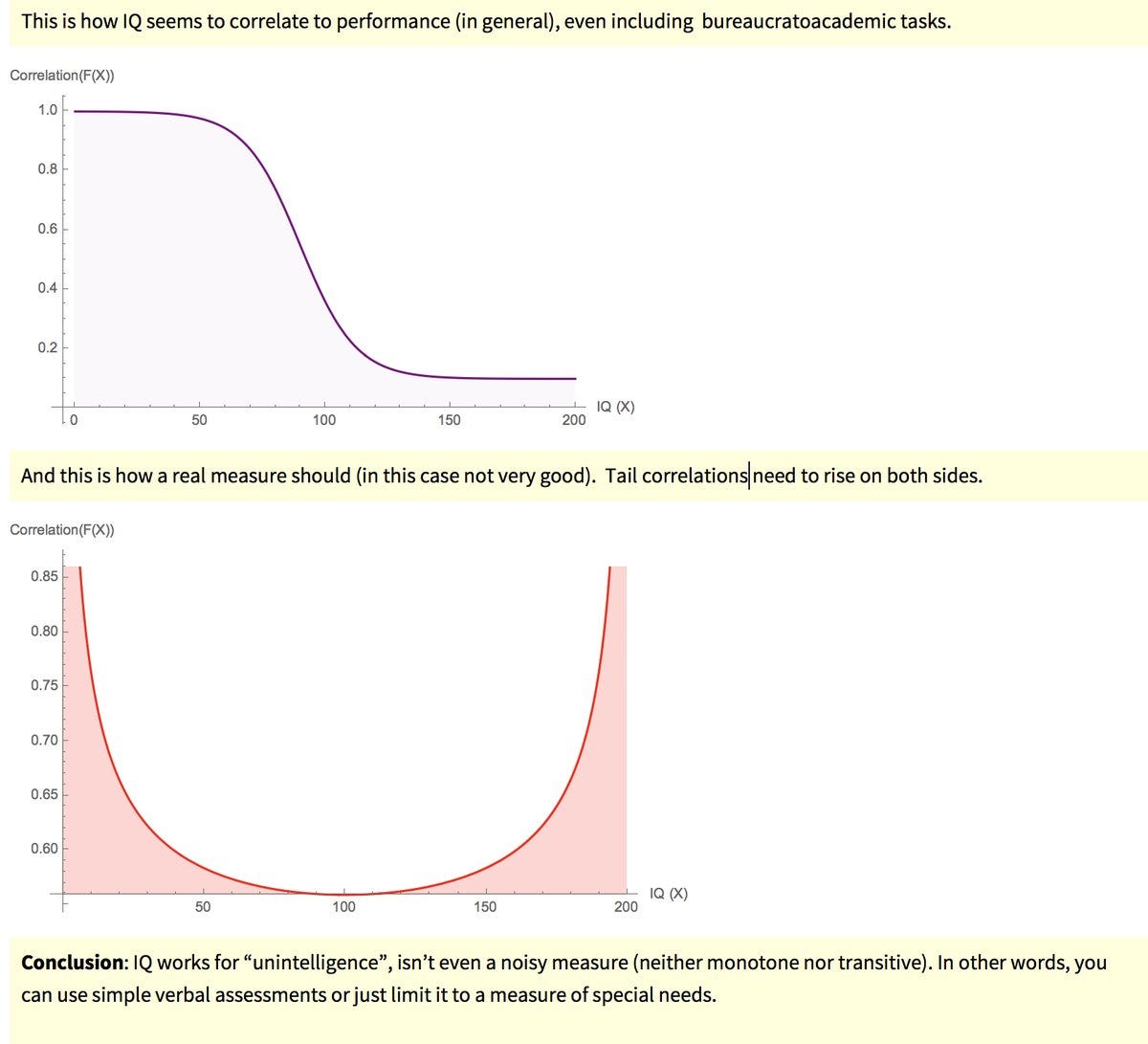
OTOH there's definitely a difference between people, people who aren't mentally defective, people that are quick on the uptake, sharp and alert, who adapt to new mental models. IQ might be an unscientific metric for identifying these people, it might leave some of them unidentified, but they definitely exist. Anyone who's worked with other people, hired other people, had to evaluate other people's capabilities, can be in no doubt about this.
It's hard to separate out Taleb's own axe-grinding from anything concrete he's trying to say about what IQ means as an independent concept. He seems more upset at short-sighted application of thought to first-order problems rather than asking higher-order questions about why the problems are problems in the first place, why the questions are being asked. When I've seen a difference between people in this degree, it's more a matter of personality than intelligence: the more detail-oriented, autistic-spectrum someone is, the more they focus only on the details, and miss out on the bigger picture. It takes a little effort to step back, but I think it can be learned. Whereas IQ (or g) doesn't seem to be improved easily with learning.