My take on this is that the unrealized valuations in the portfolio approximate a power law curve, however the realized outcomes will be bimodal if you manage your investments for bimodal outcomes. Venture capitalists are not passive investors, their behaviour is a material component of their portfolio dynamics.
So, if Fred the Investor is managing for returns across the curve, he will eventually end up with great returns in the middle of the curve. However, if (to make up a name) Bjarne the Investor is managing for bimodal returns, he will force the companies in his portfolio to give up all hope of any sub-home run outcome in the hope of having a faint hope of a home run. Bjarne's portfolio will end up realizing bimodal returns.
Speaking from my own experience, I recall taking investment from a firm who managed for bimodal returns. They were always pressuring us to hire up, and they were always telling us to stop worrying about managing our burn rate. They spoke of profitability as "premature optimization," and in fact they wanted us to spend more time talking to "strategic partners" that might end up issuing press releases about us and less time talking to customers that might end up paying us.
That kind of behaviour is going to skew the realized returns towards bimodality.
I appreciate Fred's candor in this post and I find his position reasonable.
This seems to be a response to PG's essay about superangels, including this section of it:
"So I think VC funds are seriously threatened by the super-angels. But one thing that may save them to some extent is the uneven distribution of startup outcomes: practically all the returns are concentrated in a few big successes. The expected value of a startup is the percentage chance it's Google. So to the extent that winning is a matter of absolute returns, the super-angels could win practically all the battles for individual startups and yet lose the war, if they merely failed to get those few big winners."
Recent blogs have taken issue with this claim, but I would like to see more throw their hats into the ring and specifically address the shifting dynamics among VCs, superangels, and founders.
Another issue - backing the next google may not be as profitable as you think. The founders keep a large portion of the shares, and the IPO will raise a lot but that goes into new servers or acquisitions. Then those pesky employees want stock options.
The VC firms who backed google brag about how they got 25% of a company that's now worth $600B. They don't like to mention that they were diluted (by both the IPO and employee stock options). I think they made a 100X return, which is certainly very good, but it's not as great as they make it sound.
Andy Bechtolsheim, the angel who gave them $100,000 made out like a bandit though. Something like a 10,000X return, I think.
My numbers might be wrong. But I think they make 100X, not 10,000X their investment. Which is still magnificent, but not enough to say that the only investement that matters is the one that turn into the next Google.
Huh? That quote doesn't say that returns are bimodal at all. Saying that "practically all the returns are concentrated in a few big successes" is consistent with a power law distribution. And saying that angels can "win battles" implies that some companies are successful without bringing huge returns.
True, but there have been other people arguing with more force for bimodal. pg's paragraph is fairly resonable, otheres have been more hysterical. Unfortunately, I can't dig up the links at the moment.
I'm confused - isn't this the wrong graph? Shouldn't we be looking at a histogram showing return multiple on the x axis and # of companies in that group on the Y?
Or, alternatively, return decile on the x, and total return value on the Y - this would probably end up looking somewhat bimodal, right?
Yes, I think there's a good deal of confusion about the appropriate axes - or at least talking past one another on these points.
If you take those data and throw them on a graph that looks more like Fred's, you get something that's downward sloping, but not nearly as smooth or severe as a power law curve: http://christinacacioppo.com/downloads/irrData.jpg
This isn't to say that one way of looking at this is better than another -- just that there seems to be two trains of thought right now.
For me it looks like we arrived to non-contradictory conclusion: There are two winning strategies.
The first approach is to search for IPO-capable startups, accept the large amount of misses and not care about valuations. The second strategy is to aim at multiple acquisition exists, be more selective, and pay attention to valuations. Both strategies can work, if executed well. The second strategy is trending now, but it does not overwrite the first one.
The way I interpreted PG's statement is that although (obviously) there are different ROI's for startups the main decision is not _how much_ ROI you make but _if_ you will be able to make any at all.
It's much more important to understand the dynamics at the decision point of investment (like Fred also says) whether or not you invest. Obviously the decision to invest is bimodal (you do or you don't) and you do this depending on what the investor believes the outcome (also bimodal - success or failure) to be.
From an entrepreneurs perspective you don't really care if you make 10x or 3x because at that level it's a success either way.
Cool post and great that he backed up his argument with data.
My only beef with this article is that it does not follow logically that "bimodal" returns means that you want to get in every deal. That's the "throwing good money after bad" flaw that leads to addictions to video poker and the lottery.
can we not call things "power law curves" just because they are curved like that? all distributions have underlying reasons. arrival time? mean reversion? preferential attachment? go looking for and describe the underlying causes.
The fund has not been active very long, so there's not been much opportunity to fail yet. Still, the two rightmost companies are valued well below 1x - they seem to be bankrupt or nearly so.
Sorry! I didn't know a better word for "stopped operating as an independent entity with some haste", and used "bankruptcy" without considering the possible implications for your business. (I see http://zachaysan.tumblr.com/post/1431828646/paul-graham-is-r... uses the same word, I don't hope I inspired him.)
I'll try to choose my words more carefuly next time.


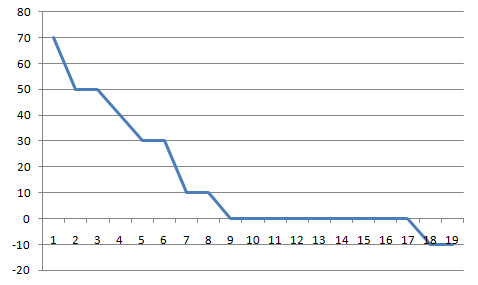
So, if Fred the Investor is managing for returns across the curve, he will eventually end up with great returns in the middle of the curve. However, if (to make up a name) Bjarne the Investor is managing for bimodal returns, he will force the companies in his portfolio to give up all hope of any sub-home run outcome in the hope of having a faint hope of a home run. Bjarne's portfolio will end up realizing bimodal returns.
Speaking from my own experience, I recall taking investment from a firm who managed for bimodal returns. They were always pressuring us to hire up, and they were always telling us to stop worrying about managing our burn rate. They spoke of profitability as "premature optimization," and in fact they wanted us to spend more time talking to "strategic partners" that might end up issuing press releases about us and less time talking to customers that might end up paying us.
That kind of behaviour is going to skew the realized returns towards bimodality.