This is how FPV jammers are often field-checked in Russo-Ukrainian war. It doesn't test frequencies or spectrum quality, but is a useful indicator, that jammer is actually emitting (has power and is turned on), so you can be sure, that if it's up to spec and covers frequently used frequencies at your location - it actually tries to do it's job, instead of being a costly paperweight.
That sounds a lot as gloating mid-febraury 2022. We all know how it turned out.
> Russia has integrated air defence, anв the shit is real, it is fight-proven, it works day and night for the last 3 years. Ask Ukrainians.
Yep. There are videos of oil infrastructure destroyed every single day. Russia is big, so it's hard to defend, and most of its air defense systems are either destroyed, or try to cope with 91 imaginary drones in Valday.
> The EU will lose about 100 planes and 50 pilots
Wishful thinking. You assume EU planes flying just above Moskow, or something like that. Won't happen and Russian planes won't be able to send air missiles to intercept them, as Russia runs out of A-50s.
> will retaliate with new conventional MRBM strikes
Oreshnik does not exist. It's an experiment, that failed to launch into [mass] production. Wishful thinking again.
> Russia will also strike one large natural gas storage, one LPG from the Gulf comes into. Russian diversants will deliver several hits to the EU energy system, probably to large distribution hubs.
This is realistic and very likely, those tactics were already tested in the past few years.
> The EU stocks will drop to 70%-50% of their current value. The euro will fall by 20%-30% against global currencies. Electricity, gas, and heat prices will rise 2-3 times; gasoline and diesel prices will increase 1.5-2 times.
Not realistic. There is oil in the world, there is a lot of oil processing in Europe. US would love to send LNG and earn a lot of money, but it won't be 2-3 times. Ukraine has shown, that Russia can't keep enough pressure to stop the economy completely, so 70-50% numbers are too high.
You are not playing a war game, you are mostly fantasizing about world dominance, as many Russians did mid-feb 2022. Yes, Russia can spoil your day. No, it can't fight and defend successfully on two fronts. Yes, it has more soldiers now and experience. No, it can't protect them on marches, it's forced to fight with FPVs and will be. Armored vehicles are lost. Air defenses are lost. Many strategic aviation, including bombers and A-50s are down. Bombers didn't even knew what hit them, no ballistic missiles needed. Few A-50s were hit by ground-based air defense systems, which is kinda ironic. EU has stockpiled air defenses which, as we know, work well against Kinzhals, Onyxes, etc. EU has Saab 340s to defend against low-flying Kalibres and drones. EU doesn't have enough interceptor drones yet, but it has enough AAGs. And you should expect the same drone swarming as done in Ukraine, to penetrate the air defense with ballistics.
So, I would expect
1) Diversions
2) PsyOps
3) Combined strikes (not as devastating as you paint them)
4) CyberOps (can count as diversions)
I would not expect
1) Air superiority
2) Destruction of Europe's industrial and military infrastructure by missiles (maybe some by GBUs, but seems risky)
3) big drop in EU stocks, or increase in pricing (unless CyberOps and PsyOps succeed)
My point is not that Russia can win the war with Europe, it definitely can not. My point is that Europe can't even start the war with Russia. It is economically and politically unsustainable for the EU locomotives: Germany, France, Netherland. It will be devastating for the entire EU political canvas when Russia's marionettes Hungary and Slovakia, backed by right-wing EU and US actors will start peddling pro-Russian (masked as anti-war) rhetoric at scale 10x from now.
My point is that the EU has a unique opportunity to outsource that war to Ukraine, but seems like blowing that opportunity.
Update: I hope you are right about RS-26/Oreshnik, but you can't spread hope on your sandwich, as an old Russian proverb goes.
Russian tactics with EU is not to start a full-scale war, but to draw aggro there, so they won't be able to chill and outsource the war to Ukraine, but instead to prepare themselves, which would limit the amount of support given to Ukraine. Make EU anxious -> EU keeps more resources at home instead of directing them to Ukraine. Even if it gets hot, advances are unlikely from both sides. (Believe it or not, but I didn't use AI to write this, I hate that it overuses some figures, so I'm forced to apologize for them).
You can hear similar individualistic rhetoric from puppets (Hungary and Slovakia, some parties in other EU countries), which themselves only get richer from the ongoing war (they provide almost no support, but get high return from taxing Ukrainian refugees, while also being subsidized by leading EU members).
Also, there is another Russian PsyOp to paint Ukraine as ridiculously corrupt country in mass consciousness, designed, again, to prevent others from providing support ("it will be stolen anyway"), which, unfortunately, plays well with Ukrainian fight with corruption (corruption scheme gets exposed, actual corruption goes down, but it's then used as an example, how corrupt it is, while in many countries, including EU, corruption is not much better, but dynamic of change is smaller, so there is no much public attention to it, and it's not magnified by Russian PsyOps).
The real attacks from Russia on EU and others are designed to weaken support of Ukraine, by any means.
Ukraine has a chance to capitalize on that, by collective defense programs and exporting extra munitions, such as drones (many companies sprung up and current production capacity is much more, that the government can pay for, so exports could subsidize locally consumed weapons, and interceptor drones are much cheaper, than missiles to intercept Shaheds aka Geran, Molnias and other, launched by hundreds each strike, sometimes even up to thousand a day), and experience, but it's slow to get to speed.
> I hope you are right about RS-26/Oreshnik
Me too, but it's not that precise anyways. It can deliver nuclear warheads, maybe it could be bettered with individually targeting submunitions, but in current form it's only good to carpet-bomb large areas, providing it could actually launch successfully. Note, that there was only one strike with it in many years, without using it they can paint it as better, than it is. Meanwhile, there were many failed launches of other IRBM/ICBMs in the last 10+ years, after giving up Yuzhmash expertise in rocket engines, leaving it to Ukraine, which can't capitalize on it financially (and US has now it's own cheap means to deliver satellites to orbit, thanks to SpaceX, so Ukrainian rockets are out of favor there as well)
> but you can't spread hope on your sandwich, as an old Russian proverb goes.
This is not a "Bucharest Memorandum", but a memorandum of a convo between Bush and Putin, which happened on April 6th of 2008. What you are talking about is from [0], and you should not believe Putin's words verbatim. Remember: he likes to "teach" history people from other side of the world. He cherrypicks some facts, omits other facts, distorts some other, and spits out some narrative to base his claims on it. Later these narratives get to school history books and become the history as russians know it. This practice is more than hundred years old by now in USSR and later Russia.
I've read your comment before visiting the site, and it got me wondering -- how bad can it be? Can it be worse than those acid green on red sites of the 90s-00s?
Imagine my surprise, when I opened the site and it looked and felt just like a museum or art exhibit. This was the literal feeling I had -- being at an art gallery, but online.
I guess, these comments tell more about the commenters, than TFA. We should remind ourselves to be more critical to the content we consume, regardless where it comes from.
I did the opposite, I opened the website before looking at the comments and thought it was like a beautiful art gallery too. Then I read the top comment, and thought 'What are they talking about??'. Had a complete opposite feeling.
The issue is that it's beautifully designed for a portrait phone-ish-sized screen. Try viewing it in 16:9 and it's a mess. I'm not saying this to criticise; the author owes me nothing, and if I shrink my browser window down then it looks lovely. But I think this is where the confusion is coming from. Half the comments are from people looking at it on a widescreen and half are on a portrait monitor or a phone. "What this website looks like" can be two very different things and nobody bothers to ask which we are talking about.
Wow. I had (just now) made one comment on the bad layout. As you might guess, I'm on desktop, and looking at the site in a window wider than it is tall. I saw your comment and shrunk my window to be half as wide as it is tall, and the layout corrects itself and changes -- dramatically.
Surprisingly, I had the art exhibit impression opening it on 16:9 desktop. It's sparse, as a gallery, or a luxury boutique, where free space accentuates value of content. It looks OK on mobile, but on desktop it's the sparse, but non-monotonous layout, that guides attention and provides a second layer to the content.
I too thought it was a beautiful art gallery, and not an article. Mainly because all I could see was art. Apparently there was an article too but I couldn't read it. I assume it was made for 21 yr olds with perfect vision and not intended for people over 40yrs old.
When I saw the article (which, for some reason, I had no trouble finding) I felt the same way, but then remembered I could adjust the font size myself with a few keystrokes.
There's an assumption, that people sometimes state explicitly, on HN that the discussion is more interesting or valuable than whatever's on the end of the posted link. Sometimes that's true - often even - but sometimes it's not.
That's not necessarily a value judgement on the discussion though. From me, at any rate, it's more often a personal perspective: sometimes I'm just more interested in or charmed by the thing, and in digesting and coming to my own conclusions about it, than I am in reading other peoples' thoughts and perspectives on the thing.
But, yeah, to me it felt almost like an old magazine: the typography, the layout, the way images are used. A lot of the discussion about web design in the 90s came about as a result of people coming from a traditional publishing background and really struggling to do what they wanted with the web medium, so to me it sort of hearks back to that a bit, does a good job of embracing some parts of that older aesthetic, but works well with modern web capabilities. Mind, I'm looking at it on a desktop browser, and maybe the experience on mobile is less good (I can't say), but overall I like it. It has some personality to it.
To some it felt like nothing as they couldn't render the content.
The challenge when tackling difficult problems is to bring in solutions to those problems.
Subway offered an alternative to junk food. By offering custom flavors of choice, giving consumers more control over what they eat. I don't see any fresh food at subway. Does it mean what they did is futile? No. Can't we point out this is another type of junk ? We better do.
The site is wonderful when rendered with JavaScript. A web to aspire to is one where the system font is set by default, at least could be chosen.
All valid concerns looking at an endeavor discussing a better web. The author may even take note and iterate, there was no claim it was definitive work.
One of the most frustrating and perhaps thought-terminating clichés on the internet and social media at large is alluded to in this reply:
“I personally could not view this page [because I turned off JS], therefore I will dismiss it out of hand as it didn’t cater to my needs.” A choice made by the consumer somehow makes the author accountable for it.
Or more succinctly, “but what about me [or people I’ve anointed myself as spokesperson for]?”spoken by someone not the intended audience for the piece, trying to make the author responsible for their need.
The answer to which, I think, is either, “it’s not for you then so move on,” or perhaps even “misery is optional, just enable JS ffs.”
The idea that the creator of a work must bend to the will of those that consume it seems to be highly prevalent, and is pretty much at odds with creativity itself.
I have found that HN is, ironically, a horrible place to post experimental work on, with a few exceptions - e.g. things "written in Rust" etc. I think it's because the majority of the commentators here haven't really made anything from scratch.
I too think it’s a beautiful website and really refreshing in its simplicity. Too often “good design” means “needlessly complex.” The design of the site also nicely fits the argument being made in the text.
I thought the same when loaded it on mobile. When I went to the desktop version, it is kind of glitchy and the images overlap the text: https://i.postimg.cc/bJgjcDD1/desktop.png
Beauty is in the eye of the beholder. My personal taste for the presentation of a piece of writing is that less is more. I usually find artwork that accompanies a text to be distracting. I love reading work that can stand on its own, invoking images in the mind. I also dislike animations that seem to be made for a certain scroll speed.
Having said all of that, I certainly don't think it's bad, nor is it a commentary on the arguments being made. It's just not my cup of tea.
> I usually find artwork that accompanies a text to be distracting. I love reading work that can stand on its own, invoking images in the mind.
But the images are a part of the work, not separate from it, no?[0]
You might have a preference against that, which is absolutely fine, but I think you're making an artificial distinction.
[0] There's obviously a separate conversation to be had about how much that part contributes or detracts with any such work, but the point stands that I tend to view such works as all of a piece including all constituent parts.
> My personal taste for the presentation of a piece of writing is that less is more.
TFA works with iOS reader mode, which is all that matters to me. I use it instinctively as it makes style more or less uniform and lets me focus on the content of the article.
I think when you make such strongly opinionated design decisions on your website, you're deliberately inviting strong criticism. They could have used a readable vanilla bootstrap theme and HN would be actually discussing the actual text content instead of the design, but they didn't, and here we are.
The idea that opinionated design is intended to court controversy or criticism is, itself, very cynical. The corollary to that is that all design should be vanilla to make it as unobjectionable to the widest audience possible.
Design and content are inseparable. When design reinforces the point of the content, that is good design, even if it's ugly, even if it's not aesthetically pleasing to you, even if it's not how you'd do it.
But I'd argue that questing for neutrality is worse than taking a stance, even the wrong stance. Besides which, what one now considers "neutral" is also a giant set of design decisions - just ones made by committees and large corporations, so the blame for its drawbacks can be passed off, and there's plausible deniability for the designer.
Someone takes risks and makes something creative they consider artistic. You're reducing their choices to a question of whether they intended to be popular or to court criticism, flattening the conversation into one about social media credit, and completely discrediting the idea that they had true intent beyond likes and points. That response itself betrays something slightly cowardly about the ethos of neutrality you're proposing.
Actually, HN wouldn’t be discussing it at all, most likely. At least not this much. The design is not only good, it has also successfully incited a passionate response from a bunch of people who don’t appreciate it. Win-win!
is one of the issues of modern web as it's optimized for quick most efficient reading, but something like this website is more optimized for slow thoughtful experience. Like some of the books about art history where you not only trying to get extract meaning of words but trying imagine how that time felt and try look on things from different perspective or different values.
Depends on your age. I remember being warned in my 20s that older people couldn't read 10pt font, 12pt was a stretch, I didn't really believe them.
Now I'm in my 40s, oh wow. Small, illegible, font is everywhere. Instructions on food is especially bad for this. At least on the computer you can usually force 125% font rendering.
Point being, the site is probably quite legible to people in their 20s.
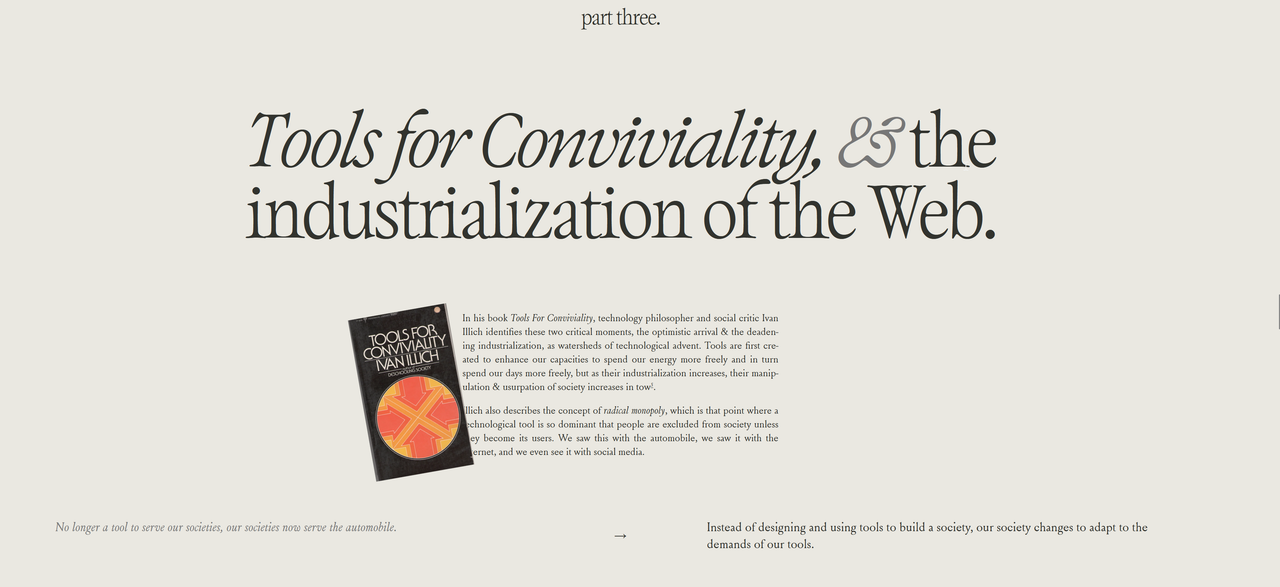
You could scale it to 120%, font would become more readable and it would even remove the text overlap with the tilted image in part three. At 100% font looks similar in size to the one on HN, but a bit less readable, I agree.
Right. I was also pleasantly surprised; it looks great, reads fluidly, and is clean on the page. It is somewhat artsy, to be sure, but nothing complaint-worthy in comparison to modern websites.
I don't think it's a bad analogy but I think there's some tension between the visual interest and making a design that makes it pleasant for someone to actually read your article through. Though even if you format it optimally for that few people bother so maybe this guy has the right idea.
> Can it be worse than those acid green on red sites of the 90s-00s?
I think people are nostalgic for the social environment that enabled people to create websites of all fashions, may they be well or poorly designed. We simply hold up the poorly designed websites as an example of how accessible content creation was ("hey, anyone can do it"), though perhaps we should hold up the better sites ("hey, look at what we can accomplish").
On the one hand, the pages were kind of ugly. Nobody likes autoplaying music. On another hand, they ruined their own site with a (separate) series of boneheaded decisions. On the other hand, Tom didn't seem quite as odious as Zuck (Myspace had a visible wall, you otherwise knew what you were dealing with with the privacy settings, and the wall was a good way to have network effects and connect with people). On another hand, Myspace worked (there was Friendster too and apparently their problem was the servers only worked half the time) because in 2006 relatively few people were online, so you knew you could find people on there
I don't know how it would have evolved if Murdoch(?) hadn't ruined the site; yes it was always a bit messy, but still. (At the same time, they completely lost all user data in some 2015 (possibly 2016) database incident, so so much for that)
MySpace has a special place in my memory for being the place I learned HTML and Flash (my profile was a flash embedded in my page) in high school, and carried on that love of creation into my engineering life.
I think it'd be good to keep in mind that Hacker News is mostly populated by a demographic commonly referred to as "Tech Bros" who, for the most part, are here as part of their journey in creating profitable businesses.
Profitable (very) was Thomas Midgley Jr. when he introduced lead petrol for cars, it took 75-100 years til the «profit» was stopped. What did we learn?
The definition of “Tech bros” is “tech people you don’t like”. There’s no agreed upon definition (just like how people disagree about what is/isn’t a “grift”) because it’s not meant to be descriptive, it’s a rhetorical device.
No, it's tech people you don't like for a specific set of reasons: it's mostly hubris and its implications like downplaying the damage the tech does to society and environment.
perceived downplaying of the damage. Popular soundbites (including "don't solve social problems with technology") have it generally backwards, and most people don't go beyond them.
No, this is too dismissive. There was a large shift in the culture of people over the last decade or so as the bay area money printers started printing faster than finance firms were printing. Eg tech money attracted a culture of people wed normally label “finance bros”. Patrick Bateman types but without the explicit murder. Status, money, often born outstandingly privileged.
This is the tech bro people speak of. It is that psychopathic desire for status at all costs which sadly is learned, emulated, and exalted. Ironically, yc is the poster child for breeding this culture over the last 8 or so years and the place it is most often complained about outside of reddit ofc.
I'm looking at the article now, and where I am in it, the header "The Invention of the Automobile," the image of someone driving, and the first paragraph of that section are all overlapping each other. I came here to type the above, then went back to that tab to find the layout had changed without me doing anything, so now "Part two," the title, and the picture are overlapping, but not the first paragraph. And the title is cut off.
That's just one complaint, but it's not me, it's the site.
I thought I could fix AMS mainboard by re-soldering connectors, so reached out to support and they helped me find which connectors I needed to buy. Unfortunately, there was more damage, that could be fixed by re-soldering them, so I simply replaced the mainboard and it was easy.
You make another drone swarm and hit drones with drones. That's how it's currently done in Ukraine with standalone small UAVs and multicopters right now, anyway. Shooting them is hard, net-shooting and shotguns work, but it must be automated, since there are a lot of them. EMP is a fairy tale, because you would also fry everything else, and the most common EMP used in wars so far is an atomic bomb. Jamming may work, if frequencies are known, and there is jamming equipment deployed for that frequency, but it's likely you need to jam video, as to not get operator to the point where they can make decision to be executed autonomously, and perhaps intra-swarm communication as well, in case of retranslators,as with a swarm it's possible to make multiple communication channels to the base, since different units can carry different sets of transmitters, so the best bet is drones hunting drones.
Simple FIR filter won't do the job, noise from the rotors and moving air is wideband and overlaps with signal.
But adaptive filters used in noise-cancelling headphones with separate mics may work. One directional microphone records sound from the scene, the other undirected one records sound of the drone, then filter tries to minimize drone sound component in the signal from the mic by adjusting coefficients of the filter.


reply